Thursday, October 6, 2011

Graphing and Estimation - Who Knew!

At the start of September Jay-Ellen had her class create a graph on what month their birthday was in.  Each student put their name and date on a mini-post it note and then lined it up above their birthday month.  They hung this graph up in the classroom for all to see.


A few weeks later she decided to use a jar that she had called "Estimation Station" and have her students estimate how many jelly beans they thought were in the jar.  Here is what the jar looked like:


They collected their estimations on mini post it notes.  When they were done doing their estimates, they then noticed they had a lot of post-it notes and needed a way to organize them.  They thought back to their graph and wondered if they could use a similar strategy to order their estimation from least to greatest.  What became tricky, and involved them using application skills, was when they had multiple estimates of the same number.   Jay-Ellen guided them to look at their graph and then see what they did when more than one person had a birthday in a month.  They knew that they could stack the numbers on top of each other.


A great way to not only compare and order whole numbers, but also to get some estimation and graphing in as well. 

Friday, September 23, 2011

Grade 3 Success Criteria

Here is a picture of the Success Criteria that Arpine created with her Grade 3 class after they solved a problem on their own.


Notice how she used a sign at the bottom of the chart to help the students reflect not only on what to put in an answer, but also on what they can do to improve their answer as well.

Using The Walls To Improve Students Strategies

Arpine's Grade 3 class was about a week into their unit on Patterning and Algebra.  She was finding that the students were always using pictures as a way to communicate their thinking.  They had been exposed to different strategies (like using a number line) but were always going back to drawing a picture.  Not only is the strategy not varied, it also was taking them a lot of time to complete their work!

As she headed to her class one day she noticed the work of Brian's Grade 6 class posted on the wall.  She stopped and had a look at what they were doing.  They too were doing Patterning but had shown different strategies in their answers.  So she decided to take her class down the hall to look at the wall before she gave them their next problem.  This is what they saw:
The "Wall" of student work.

A brief explanation of what they achieved in the lesson.

One sample of how the students found the pattern.

A second example.

When the students went back to their class something happened.  They wanted to do what the Grade 6 students did.  They now had seen different ways to find patterns, and wanted to demonstrate their thinking in a different way.  Here is a sample of the work Arpine was getting before looking at the "wall"


Here are samples of some of the different strategies that she go after the walk:

These students decided to try a number line.

This student attempted to use tally marks to help show their thinking.
To consolidate this lesson, they then created an anchor chart with the strategies that they could now use to help them when they solve a problem.  Even though they choose not to use some of these strategies, they remembered seeing them done by the Grade 6's and wanted to include them for future use.


Why Minds on Matters

Part of Sarika's Annual Learning Plan this year is to become more familiar with, and use more regularly, the three part lesson in her math class; and to become more comfortable with (and consistent with) teaching through problem solving.  Her Grade 5's are currently learning how to make a table of values and how to recognize patterns.

She has modified problems from her text to use as the "action" part of her lessons for a week.  She was able to break down the problem into multiple parts so that the problem is not only extended, but the students can use information they already know from a previous problem and apply it to the problem they are working on.

In this lesson her minds on activity was having the students identify the pattern and extend it on a table of values.  The first table was a simple growing pattern that increased by 5 each time.  The class talked about what the pattern rule would look like in words and recorded that beside the table.


For the second table of values the students were only given two terms then they were asked to talk to their partner about what thought the next term value would be.

When the students were done they gave us a "thumbs up" sign, and when the majority of the class was showing "thumbs up" the students shared what they thought the next term value would be.  One student said it would be "93" and another justified that by saying that "the pattern rule would be start at 31 and add 31 each time".  This was recorded on the board.  (We used initials and a chart to record their answers and thinking). The students were asked if this could be the only possible number.  They were then shown 124 and asked to discuss if they thought it was possible or not to be used as the next term number.

At first there were a few puzzled looks.  The majority of the class could not see that multiplication was also a way to extend patterns.  A few then began to think of "doubling" and then one student put up his hand and said that it could be the next term because if we "multiplied 31 x 2 we would get 62...62X2 we would get 124..We could then do 124x2 and get 248 for the next term."  The light bulbs went on.

Why this Minds on was important for Sarika is that it gave her a lot of information about her class.  She knows that they are able to identify and express in words what a pattern rule is, they can extend a numeric pattern, and are working on making predictions about growing patterns.  She knows that for her next few lessons, she will have to include problems and activities that involve using multiplication and addition in the patterns, and encourage the students to use these tools to help them solve problems.

Wednesday, September 21, 2011

But they only have one strategy. Now what?

Vicky gave her Grade 4 class a question relating to their upcoming Curriculum night BBQ.  The students completed a K-W-C chart to help them decode the information from the problem.  Her group of students is very comfortable with problem solving, and was not only able to quickly complete the chart, but also infer things that were in the problem (e.g., we need to remember the number of students in our class - 19).

When the students completed the problem, she noticed that almost everyone used the same strategy - Drawing a picture.  So she wondered how to get them to do things in a different way, perhaps one that is a little more quicker, and shows a bit more understanding of patterns.

Drawings of Tables

These students started to use numbers and pictures
  She got them to talk a little bit about their work in a congress.  As the pairs began to talk, probing questions were asked and that helped them pull out ideas, make connections between their thoughts and their work, and have their thinking challenged.  As the congress was going on, a chart was created to show the different ways that they could have solved the problem.


Vicky also included the statement "The pattern rule is" because she knew from her ONAP pre-assessment that the students were having difficulty in writing out the pattern rule in full using words.  After the chart was made, the students then were posed the question "If you were to do this problem again, what strategy would you use and why?"  There responses were very insightful and meaningful.  The best one was that the student commented on the fact that they would use the number line because then they would be done their work a lot quicker. :)


Getting Ideas for Problems

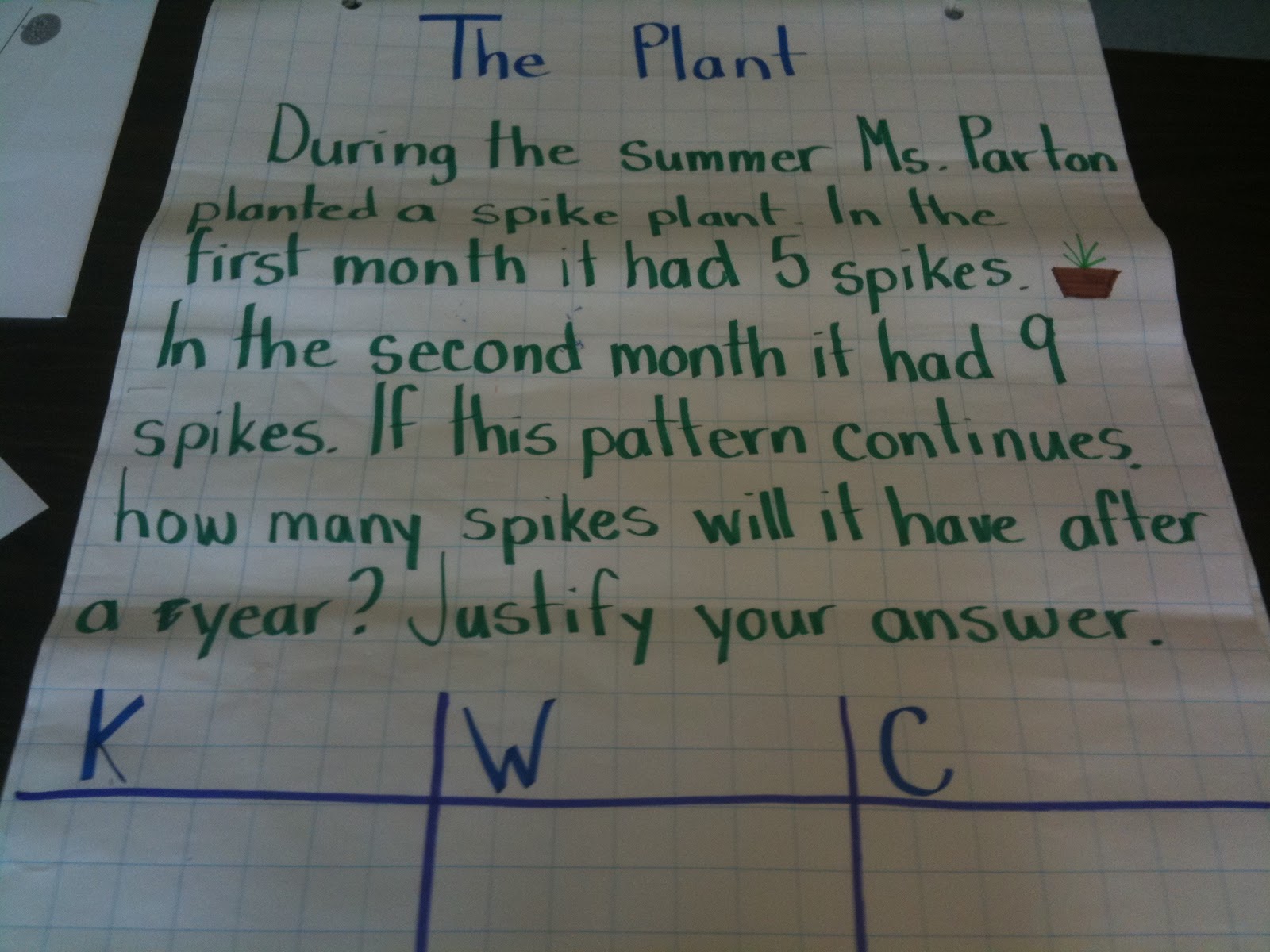
Arpine teaches Grade 3 and wants to incorporate more problem solving into her math program.  She found some problems at www.mathwire.com but wanted to open them up a little bit more so that there were more points of entry for her students.  She also wanted to introduce the K-W-C to her class to help them get started at solving problems.  In creating a few problems all at once it not only helps her with planning, but also helps her to allow her students the time to build on their new learning, and try different strategies out. 

Here are a few of the problems that she modified to meet her needs.  She used the names of teacher in the building to help make the problems more "real" to the students.  As well, she began to incorporate multi answer questions for her students to answer so they become accustom to completing mult-step questions.


One Expectation, Three Ways

Jenine, Michelle and Janice all teach Grade 3 at three different schools.  They are all working on the first overall patterning expectation of describe, extend and create a variety of numeric patterns and geometric patterns.  Here are some of the ways that they started their units. 

Jenine started her unit with looking at number patterns.  The students completed a problem about a classmate.  They also did a K-W-C chart to help them comprehend what the problem was asking of them.
The students then got to work solving the problem in similar ability pairs.  When they had completed the activity, we did a congress to consolidate their learning. 
The students who shared their work were chosen because their work showed strategies that were different.  One group re-created a hundreds chart to show what they thought the pattern might be.  This opportunity was then used to show the class how you could also use a number line to show the same thinking (and with doing a little less writing!)
At the end of the lesson, a highlights sheet was created to show the students the different strategies that they used to solve the problem.  This will then help them complete problems later on in the unit.

Michelle used a different approach to start her unit.  She began by having the students orally share what they knew about patterns.  She then had them create a pattern of their own.  When they were done making their pattern, they talked about the pattern that they had made.  Michelle recorded these words on a chart under two headings "Words" and "Attributes"

The students then went back to their desks and used the vocabulary to write about their pattern.
(Click on the picture to see what the student wrote clearer).  The students now have a good understanding of what attributes are, and how to use words to describe patterns.  From this activity they were able to demonstrate if they can create, extend and describe patterns.

Janice used technology and art to help her class get a grasp of patterns.  She gave them a digital camera and they went around their school looking for patterns that they saw in the world around them.  Not only did they capture that pattern in a photo, they then wrote about and extended their pattern the next day.  Here are a few examples of their real life patterns.

This student noticed two patterns - the colours of the desk tops and also the tiles in the floor.

A very observant student noticed that the Principal's tie and shirt had patterns in them.
Even the heater proved to have patterns in it!

Janice also has her learning goals and success criteria posted for her class to see.


Three different ways, but three great starts to the Patterning unit!