Showing posts with label Patterning and Algebra. Show all posts

Saturday, February 25, 2012

Algebra Fun

A few weeks ago myself and some teachers from our FOS attended the Y4MA Spring Conference on Patterning and Algebra.  Dr. Ruth Beatty was the plenary speaker.  I got to hear her and her writing / researching partner Dr. Cathy Bruce speak at Math Camppp, and I couldn't wait to hear her again.

During the plenary session, each group was given a "secret" equation and then represented it using two colour tiles.  Can you figure out what the rule is for each of these representations?


After a great dinner, I attended the Grade 3-6 session.  Our facilitators were Cathy Chaput and Mike Davis.  They lead us in some great discussion about algebra, and shared with us a great activity involving the book 10 Black Dots.  We had to predict how many black dots we would need should there be a sequel to the book.  This was a great experience as there were about 20 teachers in the room all working in groups of 2 - This lead us to have almost 10 different strategies that were used to help solve the problem.

If you are interested in learning more about patterning and algebra, Dr's Beatty and Bruce have a new book coming out this spring called "From Patterns to Algebra."  It is being published by Nelson Education and includes lessons, ideas on how to link the curriculum between the different grades and division, and also has videos of teachers learning, and whiteboard slides that go along with the lessons in the book.  The cost for the bundle is about $125 and includes the book and the DVD. 

OAME (Ontario Association of Mathematics Educators) local conferences are a great way to get some quick, specific PD after school that is not only cost effective, but close to home and applicable.  Next time you see one, ask your administrator if they will cover the cost for you to attend.  They are about $35 per person (non-OAME member) and usually include a great meal.  You can learn more about OAME and the local chapters at www.oame.on.ca

Thursday, October 6, 2011

Highlights at the end of a Bansho

Jenine's Grade 3 class is getting really good at using different strategies and models to show their thinking.  This was confirmed when doing a highlights sheet after doing a Bansho.  They were given a pattern and were asked to represent it in another way.  Here are some examples of the student work (the yellow slips are the pattern that they had to represent):


Here is the highlights sheet:

Friday, September 23, 2011

Using The Walls To Improve Students Strategies

Arpine's Grade 3 class was about a week into their unit on Patterning and Algebra.  She was finding that the students were always using pictures as a way to communicate their thinking.  They had been exposed to different strategies (like using a number line) but were always going back to drawing a picture.  Not only is the strategy not varied, it also was taking them a lot of time to complete their work!

As she headed to her class one day she noticed the work of Brian's Grade 6 class posted on the wall.  She stopped and had a look at what they were doing.  They too were doing Patterning but had shown different strategies in their answers.  So she decided to take her class down the hall to look at the wall before she gave them their next problem.  This is what they saw:
The "Wall" of student work.

A brief explanation of what they achieved in the lesson.

One sample of how the students found the pattern.

A second example.

When the students went back to their class something happened.  They wanted to do what the Grade 6 students did.  They now had seen different ways to find patterns, and wanted to demonstrate their thinking in a different way.  Here is a sample of the work Arpine was getting before looking at the "wall"


Here are samples of some of the different strategies that she go after the walk:

These students decided to try a number line.

This student attempted to use tally marks to help show their thinking.
To consolidate this lesson, they then created an anchor chart with the strategies that they could now use to help them when they solve a problem.  Even though they choose not to use some of these strategies, they remembered seeing them done by the Grade 6's and wanted to include them for future use.


Wednesday, September 21, 2011

But they only have one strategy. Now what?

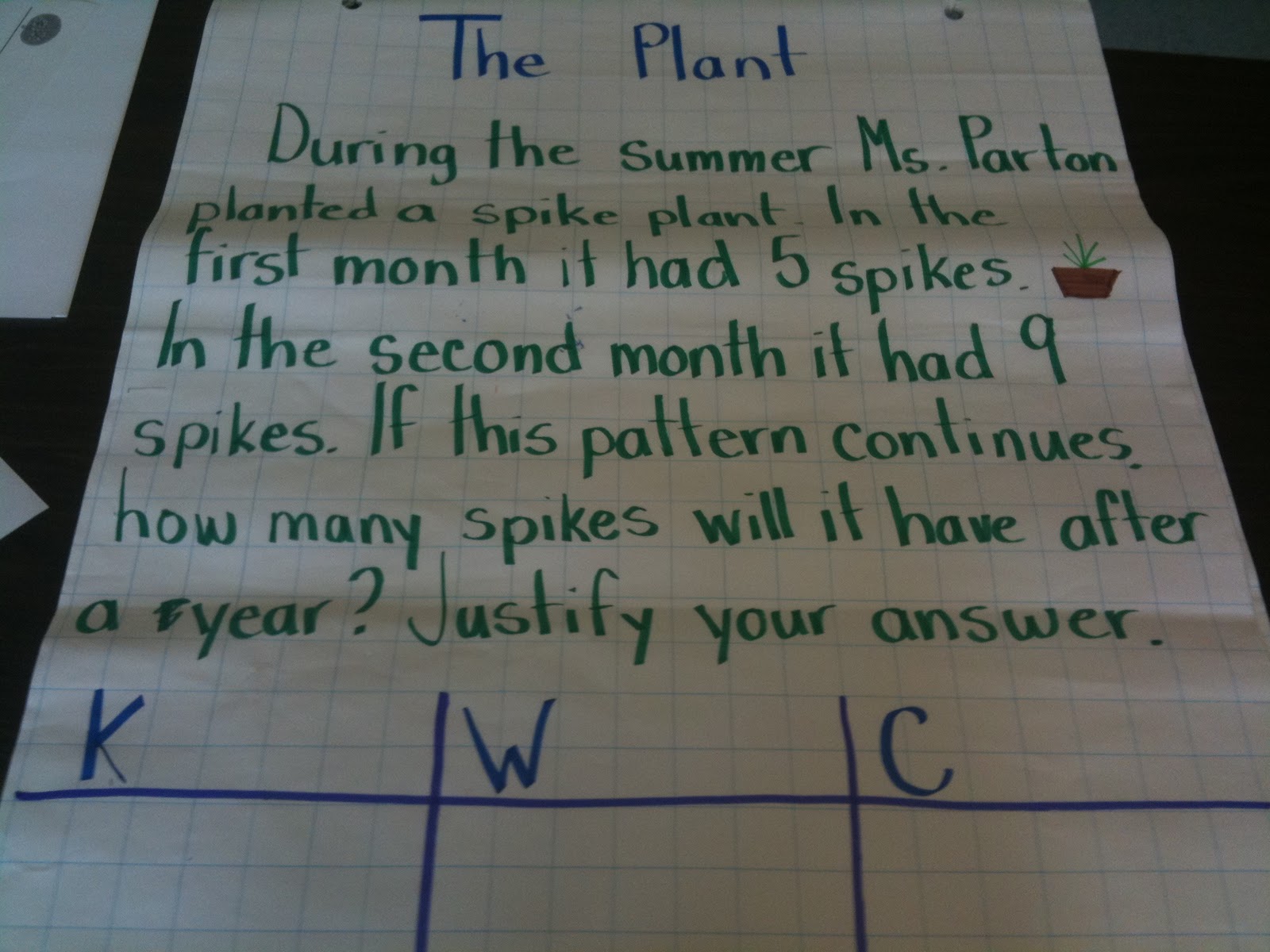
Vicky gave her Grade 4 class a question relating to their upcoming Curriculum night BBQ.  The students completed a K-W-C chart to help them decode the information from the problem.  Her group of students is very comfortable with problem solving, and was not only able to quickly complete the chart, but also infer things that were in the problem (e.g., we need to remember the number of students in our class - 19).

When the students completed the problem, she noticed that almost everyone used the same strategy - Drawing a picture.  So she wondered how to get them to do things in a different way, perhaps one that is a little more quicker, and shows a bit more understanding of patterns.

Drawings of Tables

These students started to use numbers and pictures
  She got them to talk a little bit about their work in a congress.  As the pairs began to talk, probing questions were asked and that helped them pull out ideas, make connections between their thoughts and their work, and have their thinking challenged.  As the congress was going on, a chart was created to show the different ways that they could have solved the problem.


Vicky also included the statement "The pattern rule is" because she knew from her ONAP pre-assessment that the students were having difficulty in writing out the pattern rule in full using words.  After the chart was made, the students then were posed the question "If you were to do this problem again, what strategy would you use and why?"  There responses were very insightful and meaningful.  The best one was that the student commented on the fact that they would use the number line because then they would be done their work a lot quicker. :)


Getting Ideas for Problems

Arpine teaches Grade 3 and wants to incorporate more problem solving into her math program.  She found some problems at www.mathwire.com but wanted to open them up a little bit more so that there were more points of entry for her students.  She also wanted to introduce the K-W-C to her class to help them get started at solving problems.  In creating a few problems all at once it not only helps her with planning, but also helps her to allow her students the time to build on their new learning, and try different strategies out. 

Here are a few of the problems that she modified to meet her needs.  She used the names of teacher in the building to help make the problems more "real" to the students.  As well, she began to incorporate multi answer questions for her students to answer so they become accustom to completing mult-step questions.


One Expectation, Three Ways

Jenine, Michelle and Janice all teach Grade 3 at three different schools.  They are all working on the first overall patterning expectation of describe, extend and create a variety of numeric patterns and geometric patterns.  Here are some of the ways that they started their units. 

Jenine started her unit with looking at number patterns.  The students completed a problem about a classmate.  They also did a K-W-C chart to help them comprehend what the problem was asking of them.
The students then got to work solving the problem in similar ability pairs.  When they had completed the activity, we did a congress to consolidate their learning. 
The students who shared their work were chosen because their work showed strategies that were different.  One group re-created a hundreds chart to show what they thought the pattern might be.  This opportunity was then used to show the class how you could also use a number line to show the same thinking (and with doing a little less writing!)
At the end of the lesson, a highlights sheet was created to show the students the different strategies that they used to solve the problem.  This will then help them complete problems later on in the unit.

Michelle used a different approach to start her unit.  She began by having the students orally share what they knew about patterns.  She then had them create a pattern of their own.  When they were done making their pattern, they talked about the pattern that they had made.  Michelle recorded these words on a chart under two headings "Words" and "Attributes"

The students then went back to their desks and used the vocabulary to write about their pattern.
(Click on the picture to see what the student wrote clearer).  The students now have a good understanding of what attributes are, and how to use words to describe patterns.  From this activity they were able to demonstrate if they can create, extend and describe patterns.

Janice used technology and art to help her class get a grasp of patterns.  She gave them a digital camera and they went around their school looking for patterns that they saw in the world around them.  Not only did they capture that pattern in a photo, they then wrote about and extended their pattern the next day.  Here are a few examples of their real life patterns.

This student noticed two patterns - the colours of the desk tops and also the tiles in the floor.

A very observant student noticed that the Principal's tie and shirt had patterns in them.
Even the heater proved to have patterns in it!

Janice also has her learning goals and success criteria posted for her class to see.


Three different ways, but three great starts to the Patterning unit!

Saturday, September 10, 2011

Starting A Unit - What Do They Know: Part One

In Brian's Grade 6 class this week he began to pre-assess his students' knowledge around patterning.  The first strand he is doing is Patterning and Algebra and the expectation he is reporting on this term is Overall #1:  Describe and represent relationships in growing and shrinking patterns (where the terms are whole numbers), and investigate repeating patterns involving rotations.

He began the lesson by having the students brainstorm all that they knew about patterns.  At first they did some thinking on their own and then moved into "think-pair-share" with a partner and then their table groups. 

Once they could not think of anything else, he then had them sort their words into three categories:  Attributes, Strategies/Tools, and Vocabulary.  This is now an anchor chart that they have up in the room for the students to not only refer to, but also to add onto it as new ideas and understandings come up.


Now that their schema had been activated, the students then got a chance to look at a pattern and then figure out what the pattern rule was, and also make predictions as to what the next term number would be if the pattern continued.  Here is the pattern they were given:  (my apologies as it should show as being a horizontal pattern and not a vertical pattern).


Many of them quickly picked up on that the pattern rule was "Start at 2 and increase by 2 each time."  As well, they had a discussion as to if it mattered that the colour chips were turned over or not, and if in addition to the pattern rule, if the model of the pattern was something to consider as well.  At this point one student put up her hand and said that she thought the pattern could also be "Term number x 2 = Term Value"  The students set off to explore if this theory worked for different term numbers in this pattern. 

When they came back they decided that yes, for this pattern that pattern rule worked and they could now be given any term number and find out any term value they needed to.  They then added to the anchor chart by adding the number from this pattern to the table of values so they could refer to it at a later time.
From this lesson, Brian decided to continue on to see what else the students knew about different representations about patterns.  That will be his next lesson.

Wednesday, August 24, 2011

Math Campp - Day 3 & 4 - Part Two

As with the reflections from the first two days of Math Campp, I've turned this blog post over to Gwen to get her responses on what was happening in her session during the breakout sessions.

From Gwen @ Dorset Park

On day 3 at “The Fishing Shack,” we got hooked on algebraic thinking. Inspired by the exciting Plenary Sessions lead by Ruth Beatty and Cathy Bruce, our breakout groups tackled problems about linear relations with renewed vigor. We used our own solutions and student work samples, to discuss what learning was evident and to practice giving descriptive feedback. One thing that came to light is that many of us are now feeling that we would like to pursue more professional development with a focus on specific math content. We are taking the bait!

On day 4, we spread the “net,” as in network. We developed learning goals for the Patterning and Algebra strand for our grades and shared ideas for planning for combined grades. We also talked about our understanding of what multiple representations are and what they are not. Before, I would have thought that a demonstration with three different manipulatives would do the trick, but from now on I will be introducing my students to concrete, visual, graphical, and symbolic representations, and encouraging them to make connections between the representations to deepen their thinking. Our new coolest tool in the tackle box is active graphing.

Finally, we shared resources – some tried and true, some brand . We were introduced to the Math GAINS website and were amazed by its sheer breadth and depth. This resource is sure to provide plenty of food for any who swim in its waters. It’s true that good things grow in Ontario!

Thanks Gwen!

For those of you not familiar with the GAINS website, I highly suggest you take a look at it.  It's free, and is great for learning all about ways to teach math in the province.  You can find it at:  www.edugains.ca and click on math gains.  There are also valuable links to assessment, literacy, DI and ELL learners.

Math Campp - Day 3 & 4

For Wednesday and Thursday the focus moved from Proportional Reasoning to Patterning and Algebra.  We were treated to the lovely pair of Cathy Bruce and Ruth Beatty.  Ruth instructs at Lakehead University and Cathy at Trent University.  The main focus of their research is young students and their algebraic thinking. 

From the moment they began their plenary session, we were hooked!  They showed us a method for teaching patterning and algebra that may of us were unfamiliar with.  And yet, it is so simple and so hands on, that the learning for those of us in the room skyrocketed!  In fact, many of us can't wait to get back to the classroom to try it out.  The underlying concept of additive and multiplicative thinking is what really helps students gain not only more confidence when "doing" the math, but also makes a big difference as it shows us if they really have the conceptual knowledge they need in order to move forward as mathematicians.

Look at this photo below.  (It is upside down, so please read it from right to left).  Can you tell me what equation this model represents?

1n + 9  (where n=term) or position number x 1 +9

The first position is "Zero" - There are 9 green tiles.  If you look at the 9 green tiles they show up in every term.  Therefore, the 9 must be the constant.  Just by the pure look of it, the students are now more successful in identifying the constant.
The second position is "One" - You can see the 9 green tiles (the constant) but now there is 1 blue cube.  Hmm....what times "one" gives me one?  students can now begin to make conjectures about what they think the pattern rule is.  They can then look to the third position and see if that it is always "position number times 1".
The third position is "Two" - Two times one is two (hence the two little blue cubes). And then once again there are those 9 constant green tiles.

Here is another example:

Can you see it?  This one is a little more tricky, but you can probe the students with some questions like "What do you notice is the same about each position?"  "Is there any pattens that you notice?"  In fact, you can even use different colour tiles to lay on top of the pattern to help the students test their theories and prove and reason their conjectures.  What's the answer you ask?

4n + 5  (where n=term number)  or position number x 4 +5

Once we started doing these, we then made the jump to graphing the equations and predicting about what the "12th term would be" using graphing and our knowledge of co-ordinate points. 

Great stuff to think about!