Showing posts with label Learning Goals. Show all posts

Friday, April 20, 2012

Kids Can Give GREAT Feedback!

Melissa has been working with her Grade 3 / 4 class on giving and receiving good descriptive feedback.  She decided to use the consolidation of her lesson as a way to help the students not only reflect on the posted success criteria, but also to have them work on giving their peers feedback. 

Here is how the first two parts of Melissa's lesson went:

She had the learning goals and success criteria displayed (they had co-created the success criteria together)


They then worked on the minds-on with their elbow partner (they did a think pair share and then "voted" on which on they thought it was.  Then they discussed why they didn't think that some of the choices were viable options)


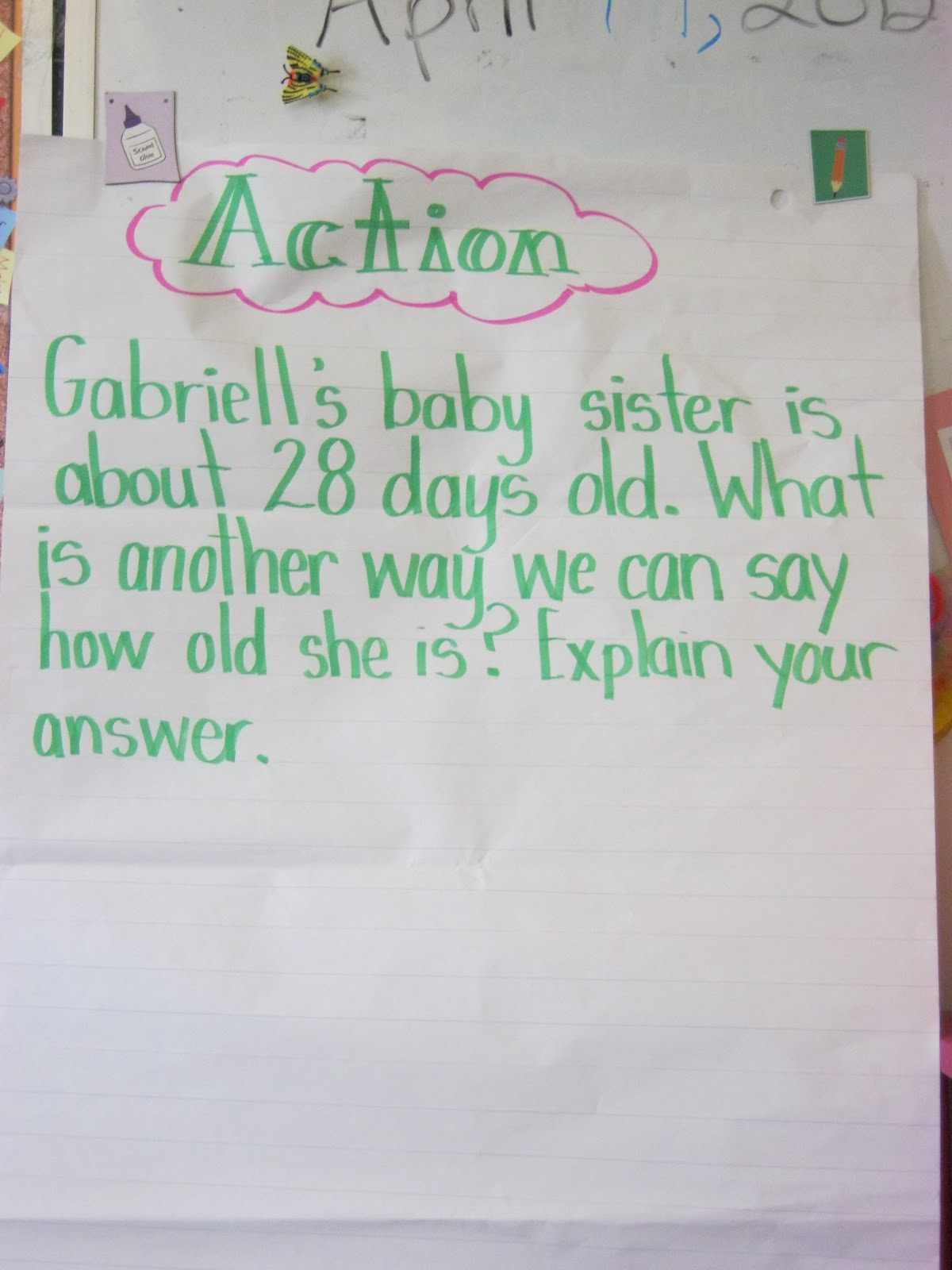
In pairs they went to work on their action:


The consolidation is where things got creative.  Here was the set of instructions Melissa gave to her class:


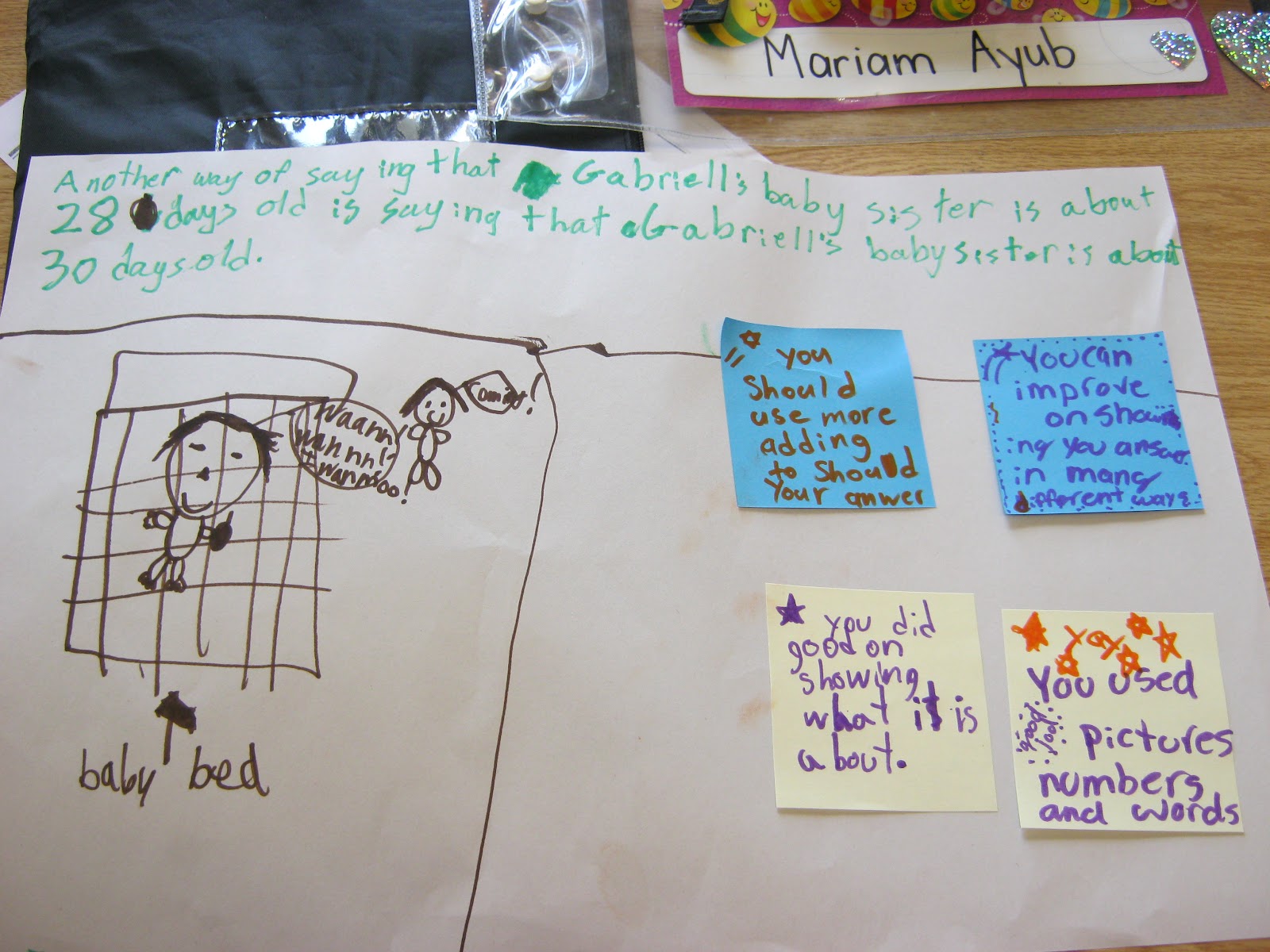
The students decided that the "star" feedback (or positive feedback) would be given on a yellow sheet, and the "wish" feedback (or things to improve upon) would be on a blue sheet.  As a whole group they gave feedback to one group's work.  They then branched out and followed the instructions they were given.  Below are all of their work samples with the feedback attached to it.  You can notice the different colours to show what was original and how they acted upon the feedback given to them:


These students are really aware of not only what makes a good answer, but how to improve to get an even better answer. 

Thursday, March 29, 2012

Surface Area....Trying It Out

Anthoula was part of our Grade 6 lesson study a few weeks ago and she really liked the activity that she saw.  She had set a personal goal for herself of trying to do more small group problem solving, and thought that the lesson she saw in Brian's class would be a great place to start.

For her minds on, she had the students brainstorm a definition of what surface area is.  Then they co-created a list of steps to take in order to successfully find out the surface area of any shape.


For the action, the class was divided into small groups based on their abilities.  Each group was given a box and the students were each assigned a task to do based on the box.  The tasks were:  create a net, justify what polygons are in the figure, find the area of each face and finally find the surface area of the box.  They then had to give an example of when they would need to use surface area.  The students were reminded to refer to the success criteria that is being created when working on their activity.


Here are some samples of the students work.


To consolidate the lesson, Anthoula offered each group descriptive feedback on what was done well, and what could be changed to help make their answer better.  For some students, she even allowed them the opportunity to reflect on what they could have added (based on the success criteria) to make their answer stronger.

Tuesday, March 27, 2012

Getting Creative With Learning Goals

Raven teaches a combined Grade 5/6 class.  Here is a great way that he got the students to not only understand what the learning goals for the unit on measurement were, but to make it creative and fun.


You can see that some of them are specific to a grade (e.g., Grade 5 or Grade 6) and others are geared towards both grades.  Since most of the measurement unit is about measuring two- and three- dimensional shapes, they used those as the backdrop for the learning goal. 

Its a simple idea, but one that not only engages the students, but will get them thinking about their learning in a positive way.

Monday, February 27, 2012

Room With An (Almost) 360 View

As our final FOS PLC have been taking us into classrooms, one thing I hear over and over again is how much people like to see how others not only have their classroom arranged, but also what they have up on the walls.  Many ideas are being "Educationally shoplifted" and taken back to classrooms all over our FOS. 

Michael has the challenge of teaching a combined Grade 6 /7.  As any teacher will say, a combined grade that spans two divisions is challenging.  But Michael is making it work.  Here is an (almost) 360 view of his classroom.  I say (almost) 360 because he does have one full wall of windows, so there is nothing posted on top of the windows.  Here is what his classroom looks like:

On his front boards, he has all of his Minds On and Action activities written out.  He also writes out his consolidation activities as well.

Samples of student work and highlights sheets are also hung up at the front for everyone to see.

Some language charts...It can't all be math :)

Learning Goals for two grades can be tricky.  Here is how Michael used some small space to make them clear and easy for the students to see.  The check marks are what the students have already worked on.

A closer view of the learning goals.

Helpful anchor charts are hung in the classroom.

The back bulletin board has some helpful things to remember about their Geometry unit.
Get out and see each others' classrooms!  If you need any help finding someone who teaches the same grade as you let me know.  I can help to arrange a visit either on a JELI or JAM day or after school.

Wednesday, February 22, 2012

Just For Problem Solving

Alla wanted to make the Learning Goals and Success Criteria she used in her class be specific to when they are problem solving.  Her goal for narrowing her focus was to really zone in on where her students are struggling in math - Problem Solving.

These are the Learning Goals she has shared with them around problem solving:
She chose to underline the key words of knowledge and understanding, apply, communicate and thinking to help the students gain greater understanding of everything that is involved in making your answer complete.  It helps the students see that there are many parts to an answer, and not just writing down a number.  This is especially critical given the fact that half of her class will be heading off to high school next year, and they need to be aware of not only the different areas on the achievement chart but also the different types of questions (or components of a question) which show different aspects of their learning.

Here is a picture of the success criteria that was co-created with the students during the course of the year :

Nothing that is on the success criteria is "new" to the students.  These have been her expectations all year long - The students can use this chart as a reference point, and Alla can use this chart to provide specific descriptive feedback to the students on how they can improve.

Friday, December 9, 2011

Learning Goals for a Rotary Teacher

Antonia teaches math on rotary.  She has a combined Grade 6/7 math class and also a Grade 8 math class.  She was a little unsure of how she was going to be able to display her learning goals for all three grades.  She knew that due to lack of space chart paper was not going to work in her classroom.  So she decided to use technology to help her.  Her school had previously done some planning so that both of her division (junior and intermediate) are doing the same expectations at the same time.  This really helps in working within two divisions.

She typed up all of her learning goals for the strand that she is teaching for each grade.  She used the specific expectations to help her create these learning goals.  She then posted them on the wall in her classroom for the students to see.  At the start of the lesson each day she now refers to the learning goals that they will be working on that day.  The students are aware of what they are learning, and are able to articulate specific things that they are struggling with.  A pro in having them up for the whole unit is that the students are able to see (in a nut shell) where they are going over the next few weeks.  (It is up to you how you want to display the learning goals - you can also do them a few at a time if that works better for your teaching style)

Here is what her wall looks like:

At the bottom of her learning goals she also has her success criteria.  This helps give the students one place to turn to when they are done their work and want to make sure that they not only understand what the goal of the lesson is, but also what is expected in their work.

Tuesday, November 29, 2011

Learning Goals as a Guide

The Grade 2 afternoon PLC took a different approach to exploring about math.  Together they co-created learning goals for the Geometric Properties and Geometric Relationships expectations in the Geometry and Spatial Sense strand.  They then were able to dive into the resources that they had brought with them to find activities and lessons that would be useful to use when teaching those specific expecations.

Starting with the Learning Goals is really helpful before you teach a unit as it really helps you focus on curriculum expectations, but also help you organize all of the wonderful ideas that you have into speficic lessons.  Here are some samples of the ideas that they came up with.


Check around in your school for the Dr. Small books and the Van De Walle books.  They should be there.  If you don't have a copy of the Guide To Effective Instruction, you can download one (for free) at www.eworkshop.on.ca  Just click on "Guides To Effective Instruction" and go from there.

Wednesday, September 21, 2011

One Expectation, Three Ways

Jenine, Michelle and Janice all teach Grade 3 at three different schools.  They are all working on the first overall patterning expectation of describe, extend and create a variety of numeric patterns and geometric patterns.  Here are some of the ways that they started their units. 

Jenine started her unit with looking at number patterns.  The students completed a problem about a classmate.  They also did a K-W-C chart to help them comprehend what the problem was asking of them.
The students then got to work solving the problem in similar ability pairs.  When they had completed the activity, we did a congress to consolidate their learning. 
The students who shared their work were chosen because their work showed strategies that were different.  One group re-created a hundreds chart to show what they thought the pattern might be.  This opportunity was then used to show the class how you could also use a number line to show the same thinking (and with doing a little less writing!)
At the end of the lesson, a highlights sheet was created to show the students the different strategies that they used to solve the problem.  This will then help them complete problems later on in the unit.

Michelle used a different approach to start her unit.  She began by having the students orally share what they knew about patterns.  She then had them create a pattern of their own.  When they were done making their pattern, they talked about the pattern that they had made.  Michelle recorded these words on a chart under two headings "Words" and "Attributes"

The students then went back to their desks and used the vocabulary to write about their pattern.
(Click on the picture to see what the student wrote clearer).  The students now have a good understanding of what attributes are, and how to use words to describe patterns.  From this activity they were able to demonstrate if they can create, extend and describe patterns.

Janice used technology and art to help her class get a grasp of patterns.  She gave them a digital camera and they went around their school looking for patterns that they saw in the world around them.  Not only did they capture that pattern in a photo, they then wrote about and extended their pattern the next day.  Here are a few examples of their real life patterns.

This student noticed two patterns - the colours of the desk tops and also the tiles in the floor.

A very observant student noticed that the Principal's tie and shirt had patterns in them.
Even the heater proved to have patterns in it!

Janice also has her learning goals and success criteria posted for her class to see.


Three different ways, but three great starts to the Patterning unit!

Thursday, August 25, 2011

Math Campp - Day 5

Our last day of Math Campp was a full morning of eating and last minute networking.  After having a brief closing session in our breakout groups, we then formed new groups with a variety of people from each of the five breakout groups. 

In these new groups we did a carousel of all the five rooms to see what they had learned and worked on.  It was great to see what things looked like (in terms of proportional reasoning and algebra) at all the different levels.  Here's just a few snapshots of the great stuff I saw during my carousel time.

In The K-4 session, there was a great poster board of different types of repeating and growing patterns.  What is neat is that in the growing patterns, two books were used: "I know and old lady" and "One Duck Stuck" were used to help explore patterns.

Growing Patterns

Repeating Patterns
In the 3-6 room they had posted Learning Goals on a continuum from Grades 3 - 6.  I've included the pictures of the learning goals for combined grades.   The Learning Goals are for the Patterning and Algebra Strand.


In the 5-8 session (where I was) we had done many activities that could be used not only as "Minds on" type activities, but also as ways to give descriptive feedback, or have students reflect on their learning (Helpful with the learning goals section of the report card).  The ideas are on the purple cards and the yellow paper are the learning goals we had for each breakout session.


The 7-10 session was lucky because they used a Mobie for part of their session.  The Mobie works in similar ways to a SmartBoard.  A key idea from this room was the chart that they had put together on ways to give feedback.  Exit passes or exit cards are a great way to get a snapshot of where you students are, and allow them a chance to reflect on their own learning.  (Once again, great for using to help give a mark for the Learning Goals and for planning!)


The final room was the 9-12 room.  In here there was math for both the academic and applied levels.  Two things that really stuck out to me in the room were the group "norms" sheet and also the Learning Goals and consolidation questions for the Grade 9 Academic and Applied classes.  I take comfort in this because in Elementary we always wonder if "high school is doing it" and this proves that they are!  How great is that consistency for our students!  The consolidation question is the question you would ask your students to make sure that you are meeting the Learning Goals set out for the lesson or the unit.

Group Norms - From the GAINS website.  Used for group work.  One teacher shared how she only needed to touch the sheet to get students back on task.

Grade 9 Academic

Grade 9 Applied
These are just a few of the great ideas that happened over the course of the week.  I've got more that I can't wait to share with you as we do our FOS based PLC's during the course of the year!  I honestly recommend attending Math Camppp next year if it is offered.  Think of it as an "Academic Vacation" it's free, it's fun and it's fabulous!

Tuesday, June 28, 2011

Intermediate Learning Goals and Success Criteria

Sharon decided to put her new learning about Learning Goals and Success Criteria into play with the last strand she was covering in this school year.  She made specific goals for each grade, but the Success Criteria remained the same.  The strand she was covering is Measurement.


Thank you so much for sharing, Sharon!