Showing posts with label descriptive feedback. Show all posts

Friday, April 20, 2012

Chocolate Does Wonders For Grade 1/2 Students

Lisa teaches a combined Grade 1/2 class.  Her students have been working on measurement.  Lisa wanted to do an activity with them that would not only be meeting curriculum expectations, but also be interesting to them.  Chocolate came to mind (who doesn't like chocolate!) and a great lesson was born from there.

For her minds-on the students had to decide what pencil to get rid of.  She scribed their thinking as they discussed what their answer would be.  Notice how she has the success criteria (in very friendly Grade 1 language) at the bottom of the page.  A great way to keep it handy and make it be able to refer to it quickly and easily.


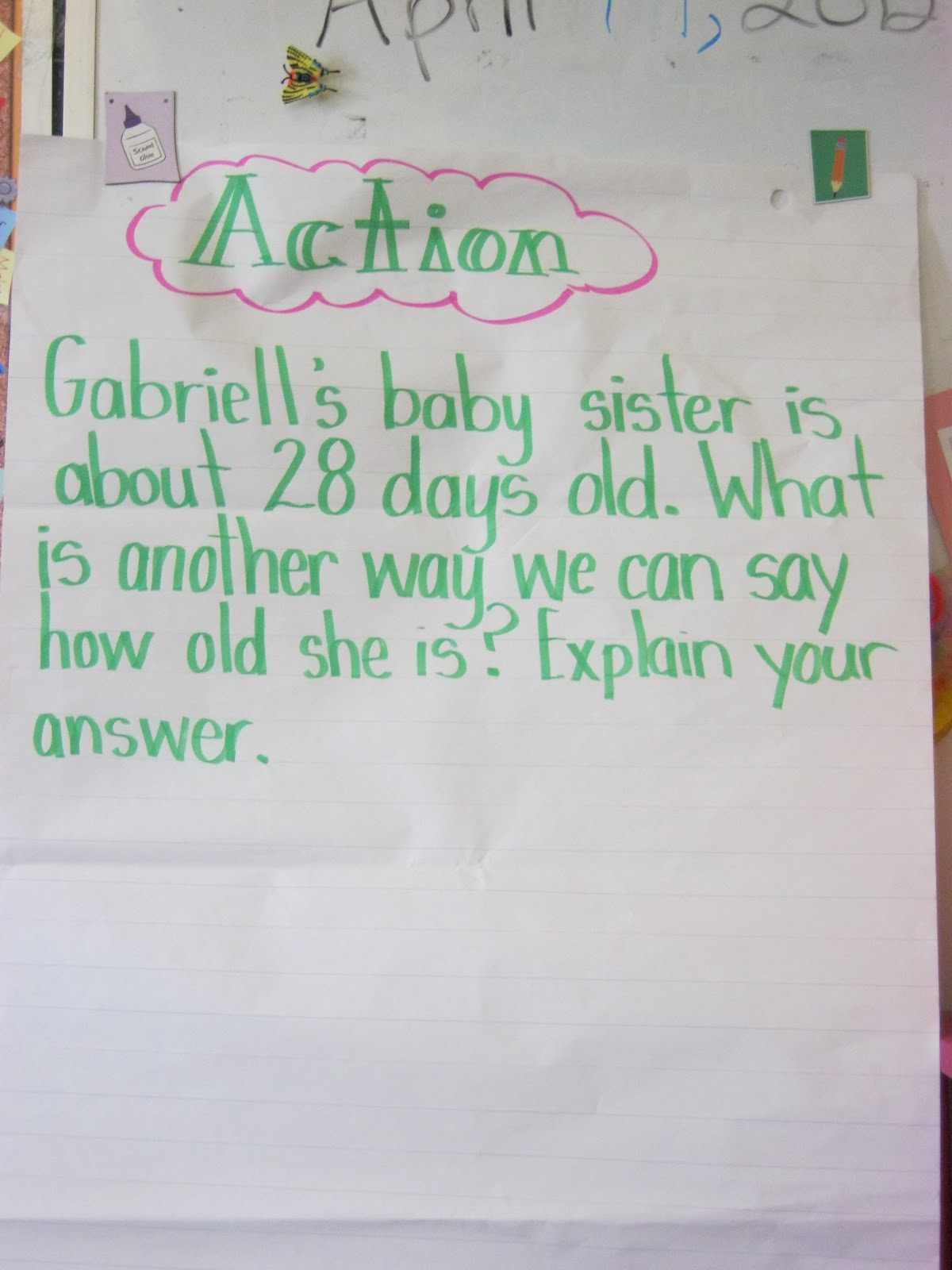
For the action is where the chocolate came in.  She gave them this problem:
The students were shown two different chocolate bars.  Lisa had made a ruler using linking cubes (which she alternated into two different colours to make the counting easier) and then the students used the ruler to help them measure the two bars.  Because there were only two chocolates, Lisa had taken a picture of the chocolate bars with the rulers underneath them.  She then created their worksheet with this picture and the question on it.  This allowed the students to write write on the photo to help them with their strategies.

To consolidate, Lisa chose a few students to come up and share their work.  She then had the class give oral feedback as to what they did that was really good, and what they could do better.  The students were really positive with each other, and listened to feedback that was given and used similar feedback with the next person.


The Answer Isn't Always Right....But I Can See Where You Went Wrong

As an intermediate teacher Antonia struggles at times to get her students to show all of their thinking.  No matter how many times she explains to them that the correct answer is only a small part of the mark they still don't show all of their steps.  For this lesson she decided to do it as a bansho and focus in a bit more on having the students give descriptive feedback to each other to help them improve upon their work.  In this problem it became clear pretty quickly that although the students were doing a good job of showing their work, they missed out on one important piece in the question and then got the final answer wrong.  But - because they showed their work, Antonia was able to see where they went wrong and help them not make the same mistake again, and their mark wouldn't suffer too much.

To start off her lesson, the class reviewed the learning goals and success criteria for this strand:


They then did a minds-on activity based on their upcoming trip to overnight camp:


The action involved them deciding what bus company they should choose to make the trip.  She offered them three choices, all with different components to think about.  What was important to remember was that the bus needed to go up to Wahanowin and back - the trip is about 250km each way.  This was what most of the students forgot to do when they solved the problem.


For the consolidation, two groups volunteered to share their work with the class.  As a group, the class gave some descriptive feedback based on the success criteria that was co-created earlier.  The feedback was recorded on our bansho and then the rest of the class set off to give feedback (on post-it notes) to one other group.


When they were done, the students then went back (and in another colour / pen) and made changes to their work based on the feedback they were given.  Here are two examples of what the "edited" work looked like.


Kids Can Give GREAT Feedback!

Melissa has been working with her Grade 3 / 4 class on giving and receiving good descriptive feedback.  She decided to use the consolidation of her lesson as a way to help the students not only reflect on the posted success criteria, but also to have them work on giving their peers feedback. 

Here is how the first two parts of Melissa's lesson went:

She had the learning goals and success criteria displayed (they had co-created the success criteria together)


They then worked on the minds-on with their elbow partner (they did a think pair share and then "voted" on which on they thought it was.  Then they discussed why they didn't think that some of the choices were viable options)


In pairs they went to work on their action:


The consolidation is where things got creative.  Here was the set of instructions Melissa gave to her class:


The students decided that the "star" feedback (or positive feedback) would be given on a yellow sheet, and the "wish" feedback (or things to improve upon) would be on a blue sheet.  As a whole group they gave feedback to one group's work.  They then branched out and followed the instructions they were given.  Below are all of their work samples with the feedback attached to it.  You can notice the different colours to show what was original and how they acted upon the feedback given to them:


These students are really aware of not only what makes a good answer, but how to improve to get an even better answer. 

Wednesday, April 18, 2012

More Than Just Time

Michelle teaches a combined Grade 3/4 class.  She is nearing the end of her measurement unit and wanted to spend a few days working with her students on noticing the relationships between days, weeks, months and years.  She used a previous EQAO multiple choice question as the base for her lesson.  However, instead of it being a multiple choice question she opened it up to an open problem.  For her Grade 4 students, Michelle wanted to review what they knew about this concept and see what other strategies they were able to apply to help them solve the problem.  This concept is one that is really based in application.  Are the students able to apply what they know about the passage of time and the relationships between days to weeks and weeks to months?  And are they able to apply a strategy to help them show their understanding (e.g., adding, skip counting, fractions)?

Her lesson started off with the learning goal and success criteria clearly posted.


The students then were given this problem as their minds on:
They did a think-pair-share with their elbow partner to share what their thinking was.  Michelle then filtered in some accountable talk by having the students share the answer that their partner said.  This was recorded in blue on the chart to help illustrate the thinking on paper.

For their action the students did a similar problem as in the minds on: 

The students were reminded to use the success criteria to help them with their answer.  They also were reminded to show their work clearly and to explain their final answer.

When the students were done Michelle did a Bansho of the strategies that they used.  She had the students talk about what was similar in all of their answers, and had them name the strategy that they used.  In total the students were able to come up with 7 different strategies.  They were:


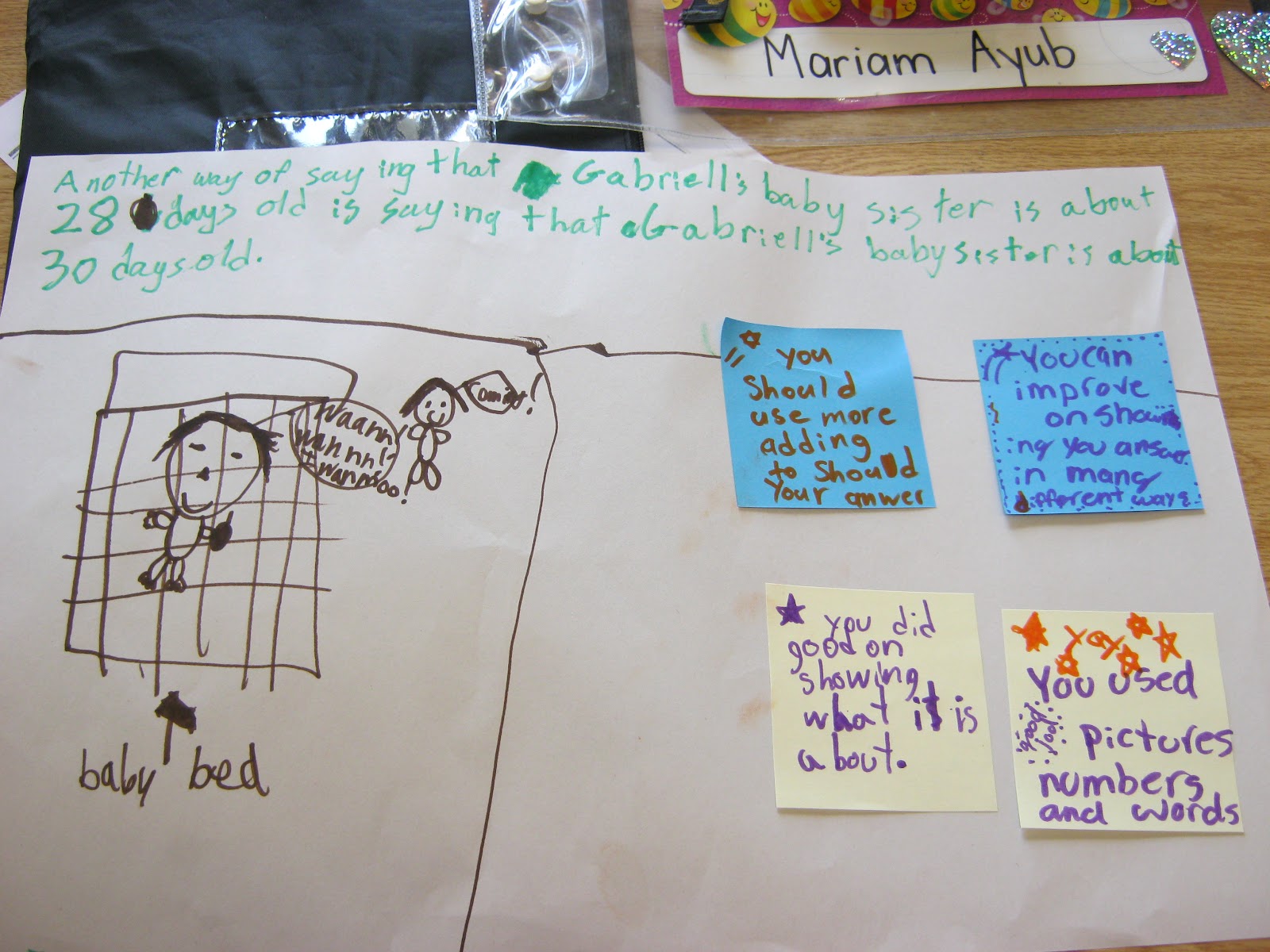
Michelle then had the students give each other some descriptive feedback on what they did well, and what they could do to improve. A great lesson with a lot of learning!

Thursday, April 12, 2012

Let's Talk About The Math!

Kristen's Grade 4 class has been working on justifying their answer.  They did an activity where they had to justify which playground they thought would be the best fit for their school based on drawings that they created.


Here are three of the answers that the students gave and the descriptive feedback that they were given (at first by the teacher, then by one student, then by the class) to help them improve next time.

Teacher feedback only.


Feedback from the previous student.

Feedback from the whole class.
As the discussions were happening, the class was really engaged and offered some great ideas as to how to improve.  They did refer to the success criteria when offering some suggested feedback.  Now they are able to take that feedback and apply it to their next task, and become better at justifying their answer.

Thursday, March 29, 2012

Using a resource for a different concept

Demitra's school has a copy of the resource "Puddle Questions:  Assessing Mathematical Thinking."  In it there is a question about how you would measure a puddle.  Demitra decided to modify the question to meet her needs for assessing what the students know about area.  She also wanted them to self-reflect on their work and she wanted to be able to give them some descriptive feedback on what they could do better.  Sounds like a tall order, but when it fit together nicely and the students really got a lot out of the lesson.


Minds-On:  Each group was given a large triangle made out of construction paper.  They were asked how they could find out the area of it.  They then set to work discussing and trying different ways.  What was great was that each group came up with a different way, and they all knew that the units that they used must all be the same.

Action:  After being given the task, Demitra reviewed the success criteria that had been co-created together.  The students gave examples of what the criteria might look like in terms of the task.  For the actual task, the students were asked to draw a puddle and find the area of it.  They could use any way they wanted to.  Some students drew lines, others used cubes, pentominoes, finger spaces, and some even drew shapes that they thought would be "easy" to count.

Consolidation:  Demitra had one-on-one conferences with each of the students to not only assign them a mark (based on the four categories in the achievement chart) but also to give them some feedback on what they had done well on, and what they could improve upon

When this student brought his work up, he came up ready to chat about why he thought he needed to make a smaller puddle.  He said it was because a smaller puddle would have a smaller area and that would be faster to count than the puddle he had drawn.  He also said that he would have used a bigger unit to measure the area with and this would also cut down on the number of units he had to use.  This is why his feedback was to think about how he could have shared his oral knowledge in a written way.
This student used a K-W-C chart to help them make sense of what they had done.  You can see there was a bit of a thinking error in their work as they used pentominoes to answer the question, but when they couldn't successfully draw them onto their puddle, they jumped to just drawing lines on the shape they had traced.  When probed, this student was unable to share why it was important that all tools they used to find the area needed to be the same size.

This lesson left Demitra feeling pretty confident in her student's abilities to find the area of a shape.  The one-on-one conferences also helped her ask some deeper questions to help determine the students knowledge and understanding of area and how well they were able to apply that knowledge and understanding to the problem at hand.

Monday, March 5, 2012

Structural Safety

Peter wanted to do a lesson that he had done previously with the family of schools during a transitions workshop.  He made a few modifications to the question, and then decided to give it to his class as part of a final assessment for his measurement strand.

His three part lesson went as follows:

Minds on:  The students talked about what they would need to rebuild a building after it had been knocked down. 

Action:  The students worked on a problem that asked them to pick which support structure they should choose and why.  They were given a choice of a cylinder, a triangular prism, and a rectangular prism.

Consolidation:  As a class, the students talked about the "Pros" and "Cons" of using each shape.  This was recorded on the chart below.


The teachers in the group then headed back to the debrief room to debrief the lesson, and also do a bit of moderated marking.  Using the achievement chart as their guide they marked several piece of student work and gave some feedback to the students.  The discussions were really rich and really centered around why a mark would or would not be awarded.  Here is some of the student work, and how it was assessed:


Part 1 of the student "a"'s work
Part 2 of student "a"'s work.
Part 1 of student "b"'s work.
Part 2 of student "b"'s work.