Sanjai's Grade 8 class is going to be starting to learn about circles and cylinders shortly, so he decided that he wanted to see what his class remembered about volume before he begun. He opened up his doors to the members of our PLC and we got to watch him and his kids in action and learned about not only what to expect when our students do this lesson, but also what we could do as teachers to make the lesson even better for the students.
Minds on: In pairs, the students wrote down every formula that they could remember for measurement. They then shared them aloud and they were recorded on the board. Sanjai had them also discuss "different" ways that they can write some of the formulae (e.g., Instead of V=lxwxh you could say: Volume is: the area of the base times height)
Action: The students set to work completing a problem from the Grade 7 measurement expectations. It is the one about finding the capacity of an aquarium that has a base that is a trapezoid. As the students were working, the teachers were having some great discussions about what they noticed the students were struggling with, and the strategies that they chose to tackle the problem. Many of the students struggled with having the "long end" of the trapezoid as the back of the aquarium. Traditionally when they see or draw a trapezoid they make the shorter end at the top, and the longer end at the bottom. This became troublesome when they had to put in the measurements of each side. Another area that the students were struggling with was where they were going to put the height of the trapezoid. They struggled because there really is two heights in this problem. The height of the base and the height of the actual aquarium (needed to find the volume which would help us translate into the capacity). Lastly, the final struggling point was using the actual formula. Because they struggled with what "B1" "B2" and "H1" and "H2" were, they were not sure what number to put where. John, one of the teachers participating drew us a great example of a 3D aquarium and also put down all of the parts of the formula down the side. This was a great way to get the kids to see what went where and why.
Consolidate: Since the students were struggling a little, Sanjai brought them back together to talk them through what they already knew about volume and what it meant. He held up the recycling bin as a way to help the students understand what they were looking for. He also did some other examples on the board of shapes they were more familiar with (e.g., rectangular prism) and how they would find the volume of that. He then used the diagram that John drew and talked them through what to put where. At this point, several cheers went out from the students as they realized they were on the right track and had gotten the right answer. Other cheers happened because the students could now see what their misconceptions were, and now had the strategies to fix it. One group cheered because they had the right answer, but had gotten it a different way. They shared their strategy with the class and were quite happy.
Here are some pictures of the student work. You can see what their thinking was as they attempted to solve this problem:
 |
| This group had to change their measurements of the B1 and B2 to make it match the measurements in the problem. |
 |
| This group was starting to decompose their shape into other known shapes. |
 |
| There were a lot of formulas being tested, and diagrams being drawn. |
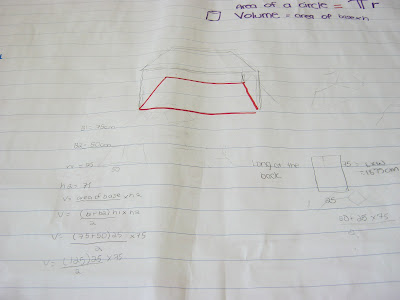 |
| This group was working with substituting the numbers to find the answer (in pencil on the left. Click on the photo to enlarge) |
 |
| Substituting The Variables. |
 |
| This group decomposed the shape into two triangles and one rectangle. They then added the area of the two together and multiplied to get the volume. |
 |
| substitutions. |
As mentioned, this lesson gave all of us participating a lot to think about. The experience gave us a chance to not only see what struggles our students may have, but give us ideas to help steer them in the right direction. Thank you for opening up your doors to us Sanjai.


