Showing posts with label Rich Assessment Task. Show all posts

Thursday, March 29, 2012

Using a resource for a different concept

Demitra's school has a copy of the resource "Puddle Questions:  Assessing Mathematical Thinking."  In it there is a question about how you would measure a puddle.  Demitra decided to modify the question to meet her needs for assessing what the students know about area.  She also wanted them to self-reflect on their work and she wanted to be able to give them some descriptive feedback on what they could do better.  Sounds like a tall order, but when it fit together nicely and the students really got a lot out of the lesson.


Minds-On:  Each group was given a large triangle made out of construction paper.  They were asked how they could find out the area of it.  They then set to work discussing and trying different ways.  What was great was that each group came up with a different way, and they all knew that the units that they used must all be the same.

Action:  After being given the task, Demitra reviewed the success criteria that had been co-created together.  The students gave examples of what the criteria might look like in terms of the task.  For the actual task, the students were asked to draw a puddle and find the area of it.  They could use any way they wanted to.  Some students drew lines, others used cubes, pentominoes, finger spaces, and some even drew shapes that they thought would be "easy" to count.

Consolidation:  Demitra had one-on-one conferences with each of the students to not only assign them a mark (based on the four categories in the achievement chart) but also to give them some feedback on what they had done well on, and what they could improve upon

When this student brought his work up, he came up ready to chat about why he thought he needed to make a smaller puddle.  He said it was because a smaller puddle would have a smaller area and that would be faster to count than the puddle he had drawn.  He also said that he would have used a bigger unit to measure the area with and this would also cut down on the number of units he had to use.  This is why his feedback was to think about how he could have shared his oral knowledge in a written way.
This student used a K-W-C chart to help them make sense of what they had done.  You can see there was a bit of a thinking error in their work as they used pentominoes to answer the question, but when they couldn't successfully draw them onto their puddle, they jumped to just drawing lines on the shape they had traced.  When probed, this student was unable to share why it was important that all tools they used to find the area needed to be the same size.

This lesson left Demitra feeling pretty confident in her student's abilities to find the area of a shape.  The one-on-one conferences also helped her ask some deeper questions to help determine the students knowledge and understanding of area and how well they were able to apply that knowledge and understanding to the problem at hand.

Wednesday, November 23, 2011

Critically Looking At Questions and Tests

The Grade 7 FOS PLC's used their time together today to look at the resources that we use, and then evaluate them on how effective they are.  We know that in our schools we have textbooks, ministry guides and supplemental activities, but there is not one "just right" resource.  So what do we do?

We started our session by looking at an activity sheet from one of the textbooks that are in our schools.
 Each teacher then looked at the questions (individually) and then we shared how we would mark each question.  When sharing, some people shared why they gave a question a specific mark (e.g., There were 4 things, so I gave 4 marks).


After doing this, we then used the achievement chart to decide what type of question each of the printed questions were.  It became very obvious to us that we had a lot of KU type questions and not a lot of communication type questions.  When we converted this into percent, it turned out that at least 40 - 50% of our questions were just KU.  We had some really good discussions which included things like:  If the question did.....or In my class they would..... - But, we were only taking things for face value - If it only shows Knowledge, then it only shows Knowledge.

After noticing what types of questions were on the sheet, we then turned to our curriculum to then have us see what expectations we were covering.  The questions that were not covered by the expectation were then crossed off. 


What we also discovered was that one of the 4 expectations found under Location and Movement in the GSS strand was not covered at all in this activity. 

The teachers then broke off into groups (1 group in the AM, 2 groups in the PM) and then picked one of the questions that was in the curriculum and then "opened it" up more.  This allowed us to have a really good question that focused on more than just one type of question - it was a question that could be used to help assess all four quadrants in the curriculum. 

The four categories at the bottom are what the teachers would be looking for when they mark each question.

Orange - Minds On,  Blue - Action, Green - Home


Monday, April 25, 2011

What Are You Looking For In A Task?

Recently at the joint Crerar and Workman PLC, the Junior and Intermediate divisions had an open discussion of what they were looking for in a good task.  After a list was brainstormed, we then went back and highlighted what part of the achievement chart that key item would address. 

What ended up happening was that we came to the conclusion that even though the students are giving us one answer, that answer is rich and covers many different parts of the achievement chart.  Look at the picture below and see if some of the criteria that they came up with would be similar to the criteria that you would want in a task you give your students.

Tuesday, January 4, 2011

Looking Critically At A Rich Assessment Task

Sometimes we can come up with a really good question or problem to give our students, but when we go to mark it, we find out that it didn’t turn out like we expected. When we give our students a rich task to work on we need to keep our own success criteria in mind when we create the task. When we start to create the task we have many good ideas, and re-word and re-write the question over and over again. When we are done we need to think about the achievement chart, and if our question A) Does allow the students to demonstrate work at a Level 4 and B) Allows us to have the students perform in all four areas of the achievement chart: Knowledge and Understanding, Application, Thinking/Problem Solving and Communication. Some teachers are Wexford are doing just that.


At Wexford, the school is continuing on its second math pathway of the year. This time they have chosen to work in grade teams instead of by division. What’s nice about this approach is that it lets the team focus on the strand, or issue, that they really want to. This week, two of the grade teams put together a pre-assessment task to administer to their students. The Grade Six team is looking at Data Management and the Grade 7/8 team is looking at Measurement.

Once each team had created their question, they then stepped back and took a more critical look at their question. They went through each area on the achievement chart and then predicted what their students would demonstrate for each area. They then created their own success criteria of what they expected to see in each of the categories.

For the Grade Six team, they also wrote out a list of possible questions that they could ask the students about the problem. They then went back and also looked at what areas on the achievement chart they question covered (e.g., was it really a higher thinking question, or was it a more basic knowledge and understanding type question). They also discussed what responses might look like at all four level s of achievement.

                                                                     Grade Six Sample
For the Grade 7/8 team, they too went through each category on the achievement chart, but then found that when they got to communication, the question didn’t allow their students to communicate at a Level 4. So with some quick tweaking, they were then able to fix the question to allow their students to communicate at all four levels.

More information on Success Criteria can be found in the Growing Success document. It’s a great activity to co-teach with either myself or the literacy coach as not only will you provide the students with information on how to improve, but it will help you to clarify what you are looking for in their work.


Thursday, November 18, 2010

What Makes A "Good Question?"

What makes a good question?  That's a great question! 

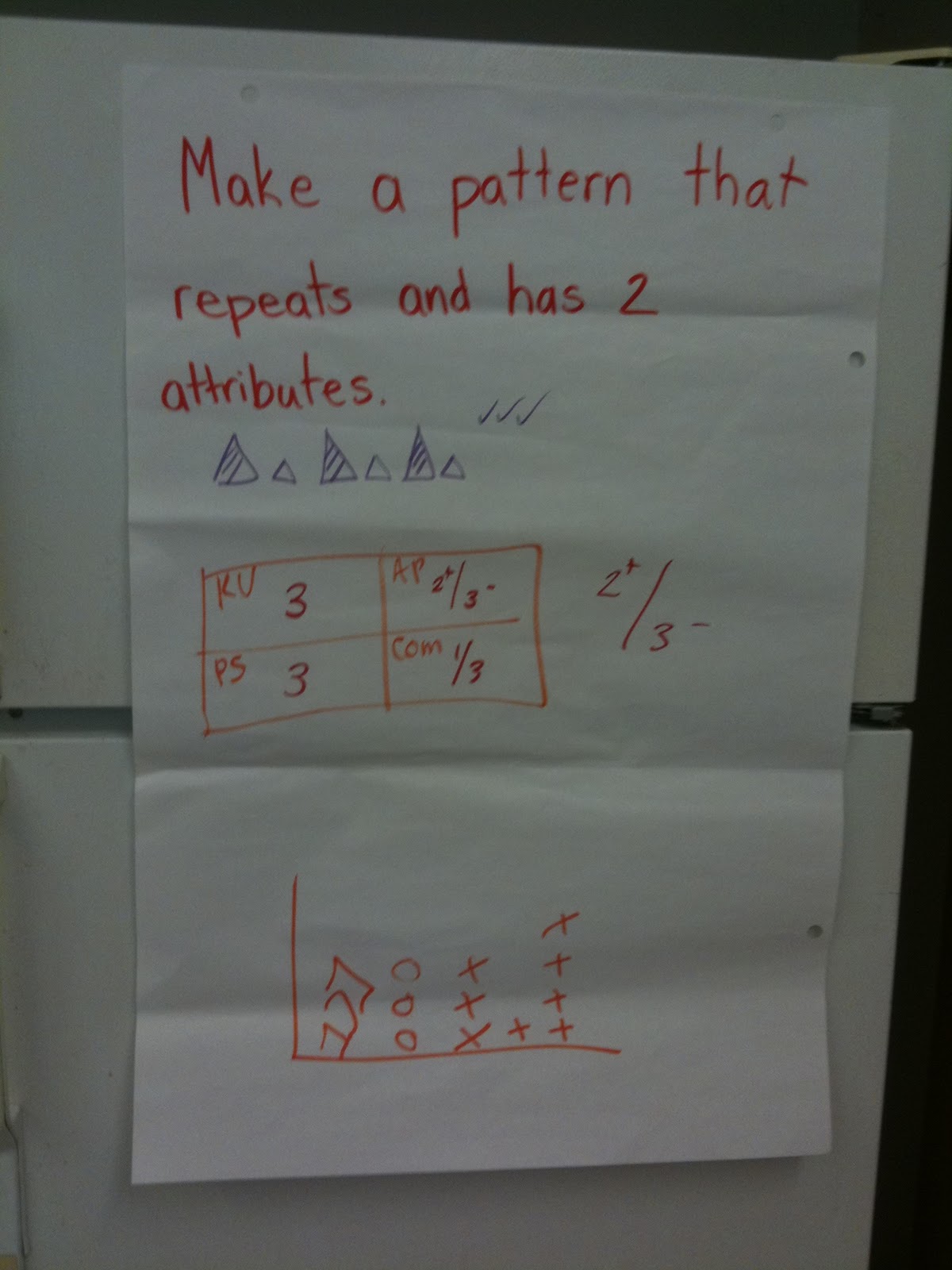
The primary division at Wexford asked just that question at the start of our pathway.  In order to set up our pre-assessment task we needed to create a question.  Not just any question, but a question that allowed us to not only meet all four levels of the achievement chart, but one that allowed our students to achieve at one of the four levels.
We looked at the above question (please ignore the writing below the purple pattern - it was our scratch pad for our thinking on another task).  We asked ourselves if it was a "good question."  Looking at the achievement chart, we noticed that it did cover knowledge and understanding - It shows us if the student can make a pattern and knows what attributes are.  Our next question became "Can a student achieve a Level 4 on this question?"  After some debate and discussion we concluded that no, they couldn't.  Quite simply because we didn't give them the chance to demonstrate they had thorough knowledge of patterns.

The second problem we looked at was very different.  As we went through the achievement chart, we were able to identify how the solution would allow the students to demonstrate their knowledge in each area, and at different levels.  It also allowed us to anticipate student solutions, and discuss ways that the student could improve in their answer.

For the pre-assessment, the teachers came up with a very open, very appealing question for the students.  It also was able to be used from Grade One to Grade Three.  It was along the lines of:

Our school council wants to design a new school t-shirt.  They want it to have a pattern that has different attributes on it.  What could the shirt look like?  Explain the pattern.