Showing posts with label problem solving. Show all posts

Monday, October 31, 2011

After the Diagnostic, Starting The Decimal Unit

Kristen began her teaching of decimals with her Grade 5/6 class by using a problem that is based on one from Making Math Meaningful by Dr. Marian Small.  (MMM, p.160, Activity 8.1).  In MMM the problem is about estimating using whole numbers, and in this case Kristen changed the problem to involve decimal numbers to hundredths and thousandths. 

The lesson was set up in Three-Part Lesson format.  Here is the lesson template:

The Minds On focused on having the students order numbers.  She chose to do this to get the students thinking about how decimals can use the same numbers, but mean different things.  We had thought that perhaps some of the students may choose to use ordering as a strategy for solving the problem, but it was not one that we saw.

The action was this problem:  (You can see the minds on at the bottom of the page...It is an Eco-school after all!)

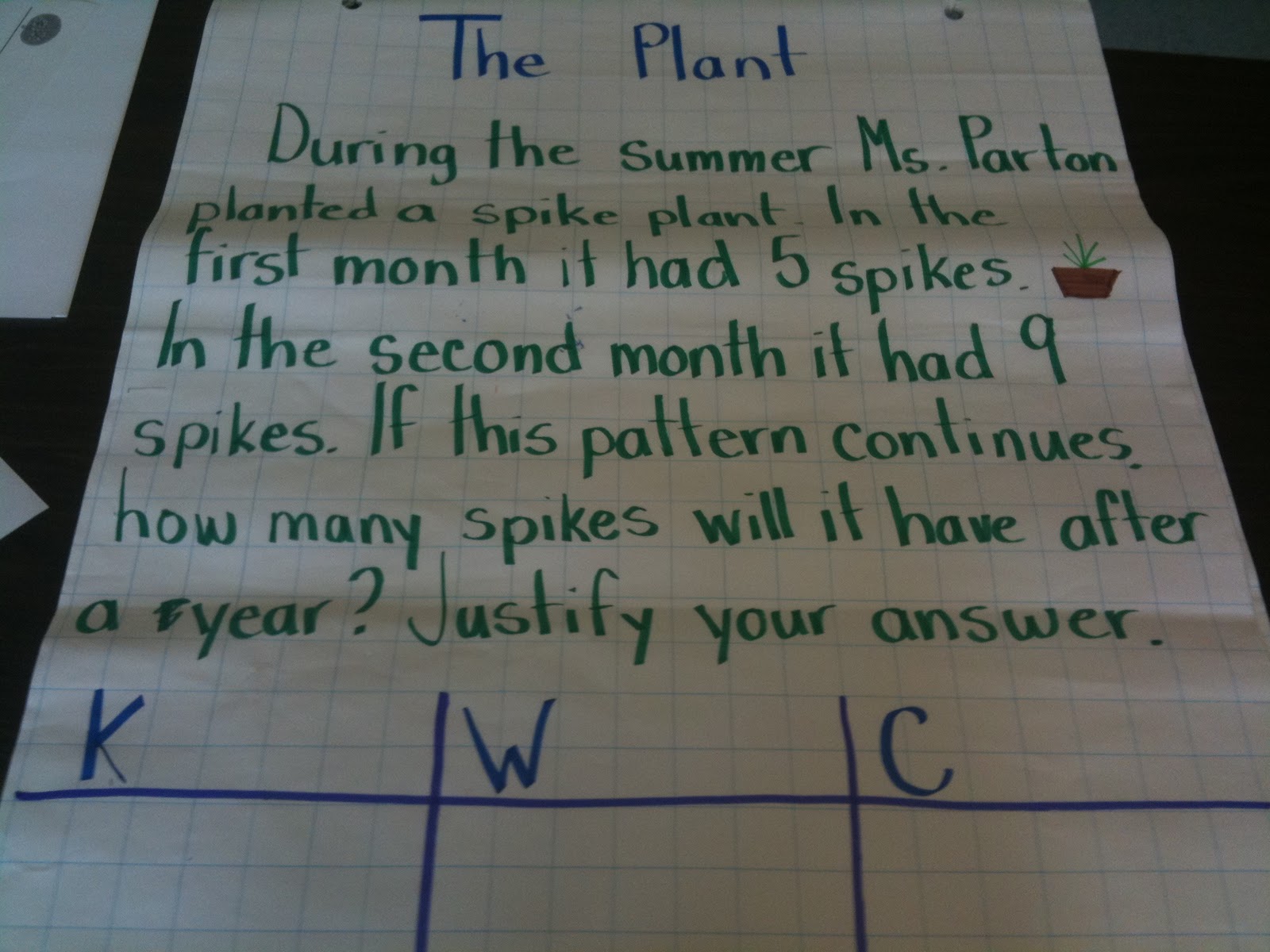
The students also completed a K-W-C as a class to help them flush out the information that was in the problem.

What was great about doing this was that the students got a chance to ask questions that were important to them.  There was some great discussion as to if the animals could only go in 2s or if they could go in groups of 3 or 4 (the answer was yes - but they could NOT go alone).  As well, one student touched upon the fact that the question was asking you to not only solve the problem, but EXPLAIN how you got your answer.  The second step that many students (and teachers) forget to do when solving a problem.

The students quickly got to work in pre-assigned pairs (based on optimal mis-match).  They used markers (no pencil's allowed) and didn't use our "banned" black and yellow (Yellow because you can't see it that well when your work is presented, and no black because that becomes our class editing pen). 

When the students were done their markers were collected.  Kristen really wanted to use the consolidation part of her lesson to help the students make sure that they were giving a really good / Level 3 answer.  So she asked the students the simple question of "What makes a really good answer?"  Using examples from their own work, the students then shared what they thought made a really good answer and why.  These thoughts were recorded on a large piece of chart paper:

The students now have an anchor that they co-created and that makes sense to them.  From it, informal success criteria was created about what makes a good answer.  A follow up lesson to this will be actually putting that success criteria on paper.

The students now were asked to add something that they thought was missing from their work.  They did this in pencil so Kristen could see what the improvement was.  (Hence why the markers were collected earlier on).  This was their independent practice.  They handed in their "updated" work and Kristen went to work providing descriptive feedback to them. 

Since we co-taught this lesson, Kristen was able to record what the students were saying about what made a good lesson as I was putting it down on the chart paper.  The student's focused on 5 different things.  To help her keep track of what the descriptive feedback she was giving to the students she numbered each item in the success criteria from 1-5.  As she gave each pair the descriptive feedback, she then recorded what she had given them feedback on, and what else she noticed that they need to work on.  Here is an example of how she recorded this information:

The first number is what she commented on, and the second or third numbers are what they still need more support in.  Its helpful to keep track of what you are saying to the student because if you notice that you are always writing the same thing, then they are not using the descriptive feedback that you are giving them and putting it into practice.

Here are the student samples showing not only their original answer, but their pencil additions and our black "editing" that matches the descriptive feedback that was given:


Start to finish, this entire lesson (Minds on, Action, Consolidation, Independent Work) took about 65 minutes.  All of the students were engaged, and all were participating in our class discussions. 

Friday, September 23, 2011

Using The Walls To Improve Students Strategies

Arpine's Grade 3 class was about a week into their unit on Patterning and Algebra.  She was finding that the students were always using pictures as a way to communicate their thinking.  They had been exposed to different strategies (like using a number line) but were always going back to drawing a picture.  Not only is the strategy not varied, it also was taking them a lot of time to complete their work!

As she headed to her class one day she noticed the work of Brian's Grade 6 class posted on the wall.  She stopped and had a look at what they were doing.  They too were doing Patterning but had shown different strategies in their answers.  So she decided to take her class down the hall to look at the wall before she gave them their next problem.  This is what they saw:
The "Wall" of student work.

A brief explanation of what they achieved in the lesson.

One sample of how the students found the pattern.

A second example.

When the students went back to their class something happened.  They wanted to do what the Grade 6 students did.  They now had seen different ways to find patterns, and wanted to demonstrate their thinking in a different way.  Here is a sample of the work Arpine was getting before looking at the "wall"


Here are samples of some of the different strategies that she go after the walk:

These students decided to try a number line.

This student attempted to use tally marks to help show their thinking.
To consolidate this lesson, they then created an anchor chart with the strategies that they could now use to help them when they solve a problem.  Even though they choose not to use some of these strategies, they remembered seeing them done by the Grade 6's and wanted to include them for future use.


Why Minds on Matters

Part of Sarika's Annual Learning Plan this year is to become more familiar with, and use more regularly, the three part lesson in her math class; and to become more comfortable with (and consistent with) teaching through problem solving.  Her Grade 5's are currently learning how to make a table of values and how to recognize patterns.

She has modified problems from her text to use as the "action" part of her lessons for a week.  She was able to break down the problem into multiple parts so that the problem is not only extended, but the students can use information they already know from a previous problem and apply it to the problem they are working on.

In this lesson her minds on activity was having the students identify the pattern and extend it on a table of values.  The first table was a simple growing pattern that increased by 5 each time.  The class talked about what the pattern rule would look like in words and recorded that beside the table.


For the second table of values the students were only given two terms then they were asked to talk to their partner about what thought the next term value would be.

When the students were done they gave us a "thumbs up" sign, and when the majority of the class was showing "thumbs up" the students shared what they thought the next term value would be.  One student said it would be "93" and another justified that by saying that "the pattern rule would be start at 31 and add 31 each time".  This was recorded on the board.  (We used initials and a chart to record their answers and thinking). The students were asked if this could be the only possible number.  They were then shown 124 and asked to discuss if they thought it was possible or not to be used as the next term number.

At first there were a few puzzled looks.  The majority of the class could not see that multiplication was also a way to extend patterns.  A few then began to think of "doubling" and then one student put up his hand and said that it could be the next term because if we "multiplied 31 x 2 we would get 62...62X2 we would get 124..We could then do 124x2 and get 248 for the next term."  The light bulbs went on.

Why this Minds on was important for Sarika is that it gave her a lot of information about her class.  She knows that they are able to identify and express in words what a pattern rule is, they can extend a numeric pattern, and are working on making predictions about growing patterns.  She knows that for her next few lessons, she will have to include problems and activities that involve using multiplication and addition in the patterns, and encourage the students to use these tools to help them solve problems.

Wednesday, September 21, 2011

But they only have one strategy. Now what?

Vicky gave her Grade 4 class a question relating to their upcoming Curriculum night BBQ.  The students completed a K-W-C chart to help them decode the information from the problem.  Her group of students is very comfortable with problem solving, and was not only able to quickly complete the chart, but also infer things that were in the problem (e.g., we need to remember the number of students in our class - 19).

When the students completed the problem, she noticed that almost everyone used the same strategy - Drawing a picture.  So she wondered how to get them to do things in a different way, perhaps one that is a little more quicker, and shows a bit more understanding of patterns.

Drawings of Tables

These students started to use numbers and pictures
  She got them to talk a little bit about their work in a congress.  As the pairs began to talk, probing questions were asked and that helped them pull out ideas, make connections between their thoughts and their work, and have their thinking challenged.  As the congress was going on, a chart was created to show the different ways that they could have solved the problem.


Vicky also included the statement "The pattern rule is" because she knew from her ONAP pre-assessment that the students were having difficulty in writing out the pattern rule in full using words.  After the chart was made, the students then were posed the question "If you were to do this problem again, what strategy would you use and why?"  There responses were very insightful and meaningful.  The best one was that the student commented on the fact that they would use the number line because then they would be done their work a lot quicker. :)


Getting Ideas for Problems

Arpine teaches Grade 3 and wants to incorporate more problem solving into her math program.  She found some problems at www.mathwire.com but wanted to open them up a little bit more so that there were more points of entry for her students.  She also wanted to introduce the K-W-C to her class to help them get started at solving problems.  In creating a few problems all at once it not only helps her with planning, but also helps her to allow her students the time to build on their new learning, and try different strategies out. 

Here are a few of the problems that she modified to meet her needs.  She used the names of teacher in the building to help make the problems more "real" to the students.  As well, she began to incorporate multi answer questions for her students to answer so they become accustom to completing mult-step questions.


Monday, April 25, 2011

I Understand The Problem - But Now What?

We know that in getting students to be successful problem solvers that giving them time to problem solve is just the beginning.  Comprehending the problem is another obstacle that students (and adults) need to overcome in order to decode the important information from the problem, and then apply skills that they have in their schema to help them solve the problem.

In Sheryl's Grade 1 class they have been doing a lot of work on not only decoding the problem, but also talking about what they can do after they understand the problem.  To help them comprehend, they have been using the KWC chart to help pull out the information that they Know, What they need to do, and things that they Can't forget.  Sheryl has also began adding onto the bottom of the problem the strategies and tools that the students brainstorm that they can use in order to help get the answer.

You can see that some of the ideas that the students came up with were:  Add - using your fingers; with number sentences; using counters. Also Draw a picture.  Great strategies for Grade 1's to use, and great strategies to use for this problem!

Tuesday, February 8, 2011

Cross Strand Problem Solving

In thinking ahead to Valentines Day, Melissa had her class complete a problem on making valentines.  Her lesson was in a three - part lesson format and was the following:
Minds on - Reading a book to them.  Action - was the following problem: Sierra made valentine cards for her friends.  It took her 5 minutes to make one valentine card.  How long did it take her to make 6 cards? (Adapted from The Math Process Standards Series K-2 by Susan O'Connell) Consolidation - To share answers and develop success criteria from it.


Although telling time to the nearest 5 minutes is not in the Grade 1 or 2 curriculum, Melissa has spent a lot of time getting her students to work on composing and decomposing numbers in different ways.  Her goal for the lesson was to have the students apply a known strategy to a problem in a different strand.  As the students were working, Melissa went around and used the Assessment for Learning tool during her discussions with the students.  This allowed her the opportunity to instantly record their strategy, answer and their errors. 
 Once the students were done, she brought them together to create a list of what made their answer good.  This will now be their success criteria for upcoming problems (photos of that to come later).  Once the students discussed what made their answer good, they then had the opportunity to go back and "edit" their work to put more detail into their answers.  You can see this in the pictures by the different colour that they used.
This pair of  students originally had the incorrect answer.  They then went back and checked their work and noticed the error.
This pair drew too many tally marks originally, they were able to see their error, but simply didn't go back to change the written portion of their answer.

I have made a video of this lesson as it really shows not only what a good three part lesson looks like, but also how you can create success criteria with your class.  If you would like to see the video, or want help in creating success criteria with your class, please let me know.

Tuesday, January 4, 2011

Blokus Tournament!

To end of their transformational geometry unit, Paul’s Grade 6 class participated in a Blokus tournament.  Blokus is a game that involves using problem solving skills, and strategies, to help you cover as much of the game board as possible.  One you select a piece you not only need to decide where you want to put it, but also how you are going to transform that shape into the space you have provided.  As the game goes on, students really need to use their knowledge and understanding of transformations to make the pieces fit, or else they’re out!

The class was divided into six teams of four.  Three teams were on each side of the classroom.  There was a scoreboard posted on the blackboard to help keep track of who was advancing to the semi-finals and what everyone’s score was.  For those that didn’t win at their game, the score was still important because the person on each side with the best score (who didn’t win the match at their table) got to be put into a “wild card” spot and advance to the semi’s.  After the semi-finals, the same process was repeated with two winners and two “wild cards” advancing onto the finals.
The final round was played on a giant Blokus board.  The whole class crowed around it to see the final match.  It was interesting to watch the spectators as they were so quiet!  Every now and then one of them would whisper to the person beside them and share what piece they would have used, or a move that they would have made if they made it to the finals.  What was even better to see was that once the “Blokus Champ” was named, all of the other players shook hands and congratulated each other on a game well played.
As an FOS we have a class set of Blokus games that you can borrow to use with your class.  If you are interested in using them, please e-mail me and we can make some arrangements.  As well, if you want to learn more about Blokus, or play an electronic version of Blokus on-line or on your mobile phone you can visit www.blokus.com

Wednesday, December 22, 2010

Problem Solving In Kindergarten

In Artemis' Full Day kindergarten class, her students were given the opportunity to problem solve - and connect that problem to a larger school wide issue. The school had adopted 6 families for the holiday season.  Students and their families were asked to donate clothing, food and personal items to help support the cause. 

For the minds on part of her three part lesson, Artemis read the students the book "The Jacket I Wear In The Snow" to get the students thinking about items you need for winter.  The problem (action) that Artemis gave her students was this:  We've been collecting clothing for families in need.  We can put ten things in each box we give them.  We are going to make boxes of hats and mittens.  What combinations of hats and mittens could you put in a box?

The students did a wonderful job of creating various boxes with different combinations of hats and mittens.  As they worked, Artemis was able to record not only the combinations that they made (e.g., 4 hats and 6 mittens) how they counted (was it one-on-one, did they count by 2s?) and probe them to explain their thinking (How do you know you are done?  Why do you think you have put ten things in the box?).

To finish off the lesson, (consolidate) the students came back to the carpet and recorded their boxes on a chart.  Artemis then continued to ask questions about the boxes that the students made.  (Who had more mittens in their box?  Alyssa or Shiva?  How do you know?)

Thursday, November 18, 2010

Let's Start At The Beginning

In Heather's Grade 2/3 class she wanted to start problem solving with her students on a more regular basis. In the lesson we co-taught we wanted the students to get comfortable with some of the logistics of problem solving.  Things like working in pairs, using a marker to write their answer down, and crossing out wrong answers.  These are all huge steps students have to overcome in order to show their thinking.  We also hoped to see what different strategies the students used to help her get an idea of where to go in her lessons (Assessment for Learning)

For some students, they took to the challenge like it was nothing new.  For some, they needed to be silly with the markers and draw on their hands for a few minutes before they got to work.  Getting the students to write an answer down was the hardest part.  Many of them were afraid to make a mistake and wanted to make sure that they they put down the right answer - or put down what Heather and I were looking for. 


When we congressed, we had the students look at how there were many different strategies that they could have used to solve this problem.  We labeled each strategy, and then posted them on the black board in a Bansho so the students could see what their next logical strategy was.


It was a very successful first try at problem solving (and co-teaching).  At times we worry about how "messy" the student work is.  But we need to remind ourselves that it is okay to be "messy" as it shows us how our students think, and how we can help them become clearer in their though process. 

Sunday, September 19, 2010

One Question, Multiple Strategies

I've spoken before on the importance of teaching through problem solving, and how it truly benefits the students as it allows them to make meaning from the math, rather than us telling them what to do.  In Paul's Grade 6 class we co-taught a lesson on number patterns. This three part lesson gave us a great understanding of where the kids were at, and where we could take them next.


We began by completing a KWC -P chart with the class.  The "P" stands for plan.  We chose to add this to our regular KWC because he was finding that his students were very reluctant to get started on any type of activity, and thought that if they had some pre-discussion on what to do, they may be more independent and more successful.


As the students were working on their problem (in pairs) Paul went around and visited each pair and probed them on their thinking and ideas.  I worked with one pair a little more closely to help make sure that they were on task, and focused.  We used the assessment for learning tool (A4L) to keep track of what strategies the students were using.  Originally, we thought that they would use one of five strategies.  However, we added a sixth strategy as one group used a strategy we hadn't thought of.


We chose three different groups to share their solutions with the class as part of our whole class consolidation.  One group had the right answer, but didn't have a complete solution as I don't think they picked 13x8 = 104 on their first try!  As the group was telling us what they did, I filled in the blanks for them by using a different colour marker.  We called this "editing."  You can see samples of it below in some of the pictures.

The second group was the pair that I was working with.  We chose to have them share for multiple reasons.  One of the reasons was to build their confidence.  Both students are currently on an IEP and need a chance to participate and show their strategy.  A second reason was that they had put a lot of depth and thought into their answer and gave not only the answer, but a suggestion as to what the leftover money could be saved for.

The third group really blew our minds.  They got an answer of 7.7  At first, I thought they were way off base, but when I began to ask some questions about how the 7.7 came into play, a lot of knowledge and understanding came into play.  The 0.7 of the lawn was because the student has a dog.  Her mom doesn't cut all of the grass each time she mows because the dog likes to have longer grass to play in.  Therefore, if the student mowed her mom's lawn she wouldn't charge the full price for the lawn mowing.   She would only charge 0.7 of what her regular cost is. 

We then had the rest of the groups come and put their work up on the board in a Bansho format.  In total, we ended up with 6 different strategies that were used to solve this problem.  So much richer and more meaningful than us showing the students 1 strategy and making them use it.

Welcome Back!!!!

Welcome Back to the 2010 - 2011 School Year!

During the second last week of August I was lucky enough to be a part of Math E Motion - A week long camp for teachers and students (in Grades 6-9) which focused on teaching and learning through problem solving.  The culminating activity for the students was a hands on project that was based on a math problem they had chosen earlier on in the week.  The students picked "Under The Sea" as the theme for all of their projects.  They showed these problems to their peers, parents and friends at an afternoon long "Math Fair."

Over the course of the 5 days, they worked together in partners to take the problem off the paper and make it come to life.  In total there were 18 different projects.  Each pair had different strengths and weaknesses, and each pair was also working at different academic levels.  The end results were nothing short of spectacular!  The students really worked hard, and put forth some excellent work.  Should the program run again next summer, I highly recommend participating in it.  You will be glad that you did.  If you want to run a "Math Fair" in your school, or have questions about it, please let me know.  I'd love to work with you to make one happen!


This problem was finding out the minimum number of moves you needed to make to cut off the dragon's heads and tails - For if you made one cut, one or two more things could grow.

Probability and logical reasoning are at the heart of this activity where you had to guess which box had 2 blue balloons, 2 pink balloons and 1 blue and 1 pink balloon.


For this game you have to place the numbers 1-8 in a row to find out what the greatest possible sum could be for each row.

Friday, April 30, 2010

Student Success in an HSP Class


Karen's HSP class is composed of a variety of students, all at different levels of ability. She has been trying out problem solving in her class and has been surprised at the results. She has been encouraging the students to use a graphic organizer (seen above) to help her students comprehend what is being asked of them.
Karen is finding that the level of engagement her students have has increased since they started doing problems. As well, she admits that the first few times made her want to pull her hair out - But - now that the students have more schema to draw upon, they are achieving success and doing so independently.

The second picture shows some student samples from a problem that the class had done around fractions.