In Artemis' Full Day kindergarten class, her students were given the opportunity to problem solve - and connect that problem to a larger school wide issue. The school had adopted 6 families for the holiday season. Students and their families were asked to donate clothing, food and personal items to help support the cause.
For the minds on part of her three part lesson, Artemis read the students the book "The Jacket I Wear In The Snow" to get the students thinking about items you need for winter. The problem (action) that Artemis gave her students was this: We've been collecting clothing for families in need. We can put ten things in each box we give them. We are going to make boxes of hats and mittens. What combinations of hats and mittens could you put in a box?
The students did a wonderful job of creating various boxes with different combinations of hats and mittens. As they worked, Artemis was able to record not only the combinations that they made (e.g., 4 hats and 6 mittens) how they counted (was it one-on-one, did they count by 2s?) and probe them to explain their thinking (How do you know you are done? Why do you think you have put ten things in the box?).
To finish off the lesson, (consolidate) the students came back to the carpet and recorded their boxes on a chart. Artemis then continued to ask questions about the boxes that the students made. (Who had more mittens in their box? Alyssa or Shiva? How do you know?)
Wednesday, December 22, 2010
Bansho For Where To Go Next
As part of Wexford's Math Pathway, the Junior and Intermediate divisions decided to focus on strategies. To help them gain a better understanding of what strategies their students had for Patterning and Algebra, they had them do a pre-assessment task prior to their PLC. The pre-assessment was done "cold turkey" with no pre-teaching prior to giving it to them. This allowed the teachers to get a real understanding of what strategies their students already had in place.
Where things changed was when they began to look at all of the strategies that their students were using from Grades 4-8. Each teacher looked through their pile of work, and pulled out the different strategies that their students were using. We then assembled those strategies into a Bansho format.
By doing this, it allowed us to look at the strategies that students already had - But also allowed us the opportunity to look at strategies that we may have not been familiar with and see how to use them. As well, it allowed us to make note of strategies that we want to model for our students, and also allowed us the chance to see how to help move out students along in their development of strategies.
Where things changed was when they began to look at all of the strategies that their students were using from Grades 4-8. Each teacher looked through their pile of work, and pulled out the different strategies that their students were using. We then assembled those strategies into a Bansho format.
By doing this, it allowed us to look at the strategies that students already had - But also allowed us the opportunity to look at strategies that we may have not been familiar with and see how to use them. As well, it allowed us to make note of strategies that we want to model for our students, and also allowed us the chance to see how to help move out students along in their development of strategies.
Friday, December 3, 2010
40 Teachers and Tarps?!?!
Recently 40 teachers from South East One got together to create their very own learning carpets. The Learning Carpet is a great tool to use in your classroom as it can cover everything from teaching numbers to graphing. It's also very hands on and a great way for kinestetic learners to complete an activity. Our "carpets" were made from masking tape and tarps. It was a great night had by all. For more information about The Learning Carpet, check out Wendy Hill's website (she's the creator of the carpet) http://www.thelearningcarpet.ca/
Thursday, November 18, 2010
Organizing Your Mark Book
One of the great things about the Growing Success document is that is gives us a strong picture of the types of assessment we need to be doing on our students: Assessing for Learning, Assessing of Learning and Assessing As Learning. Assessment can be recorded in many different ways: anecdotal notes, descriptive feedback and as marks in our mark book.
The Junior Division at Manhattan Park looked at different forms of assessment during their PLC for math. What really "clicked" for them was an idea that they saw in the Damian Cooper book "Talk About Assessment" which all of your schools have a copy of. In thinking of the types of questions they were asking, they also started thinking about how they were assessing the questions. They saw a sample of a mark book where the students were marked in each of the areas of the achievement chart and decided to try it for the unit they were working on.
What Doris and Diana said they liked about this chart (which they modified to meet their needs) was that they could look and see what types of questions they needed to assess to make sure they were getting the true picture of their student's progress. As well, the area at the bottom really allowed them the opportunity to record their observations of each student. This allowed them to have a bank of comments for the report card that was not only student specific, but in parent friendly language.
You can also help parents understand why there is more to a mark in math than just answering questions like 8 x3 = 24, as you can show specific question types their child was successful in, and struggled in.
The Junior Division at Manhattan Park looked at different forms of assessment during their PLC for math. What really "clicked" for them was an idea that they saw in the Damian Cooper book "Talk About Assessment" which all of your schools have a copy of. In thinking of the types of questions they were asking, they also started thinking about how they were assessing the questions. They saw a sample of a mark book where the students were marked in each of the areas of the achievement chart and decided to try it for the unit they were working on.
What Doris and Diana said they liked about this chart (which they modified to meet their needs) was that they could look and see what types of questions they needed to assess to make sure they were getting the true picture of their student's progress. As well, the area at the bottom really allowed them the opportunity to record their observations of each student. This allowed them to have a bank of comments for the report card that was not only student specific, but in parent friendly language.
You can also help parents understand why there is more to a mark in math than just answering questions like 8 x3 = 24, as you can show specific question types their child was successful in, and struggled in.
How To Organize A Unit
In Ontario, we have a specific Math curriculum that we follow. At times, the expectations seem overwhelming, and knowing where to start can be tricky. Backwards Mapping is one effective strategy that helps us keep track of not only where we want the students to end up, but also where we want to take our students. Creating a unit plan is another strategy.
Maryna used the template below to plan out her unit on Patterning.
She laid out a progression to her lessons, being sure to include tasks that were purposeful, used technology, and allowed her students to demonstrate understanding at all four levels (and categories) of the achievement chart. The plan is not set in stone. As she progressed through the unit, she made changes based on what her observations of the student were - Assessing for Learning, Assessing As Learning - and made sure that she helped close the "gaps" that her students may have had in their learning.
Having a plan not only allowed Maryna to focus more on the students, but it also allowed her the opportunity to make sure that she met the curriculum expectations for her grade, thus preparing them for the future.
Maryna used the template below to plan out her unit on Patterning.
She laid out a progression to her lessons, being sure to include tasks that were purposeful, used technology, and allowed her students to demonstrate understanding at all four levels (and categories) of the achievement chart. The plan is not set in stone. As she progressed through the unit, she made changes based on what her observations of the student were - Assessing for Learning, Assessing As Learning - and made sure that she helped close the "gaps" that her students may have had in their learning.
Having a plan not only allowed Maryna to focus more on the students, but it also allowed her the opportunity to make sure that she met the curriculum expectations for her grade, thus preparing them for the future.
Let's Start At The Beginning
In Heather's Grade 2/3 class she wanted to start problem solving with her students on a more regular basis. In the lesson we co-taught we wanted the students to get comfortable with some of the logistics of problem solving. Things like working in pairs, using a marker to write their answer down, and crossing out wrong answers. These are all huge steps students have to overcome in order to show their thinking. We also hoped to see what different strategies the students used to help her get an idea of where to go in her lessons (Assessment for Learning)
For some students, they took to the challenge like it was nothing new. For some, they needed to be silly with the markers and draw on their hands for a few minutes before they got to work. Getting the students to write an answer down was the hardest part. Many of them were afraid to make a mistake and wanted to make sure that they they put down the right answer - or put down what Heather and I were looking for.
When we congressed, we had the students look at how there were many different strategies that they could have used to solve this problem. We labeled each strategy, and then posted them on the black board in a Bansho so the students could see what their next logical strategy was.
It was a very successful first try at problem solving (and co-teaching). At times we worry about how "messy" the student work is. But we need to remind ourselves that it is okay to be "messy" as it shows us how our students think, and how we can help them become clearer in their though process.
For some students, they took to the challenge like it was nothing new. For some, they needed to be silly with the markers and draw on their hands for a few minutes before they got to work. Getting the students to write an answer down was the hardest part. Many of them were afraid to make a mistake and wanted to make sure that they they put down the right answer - or put down what Heather and I were looking for.
When we congressed, we had the students look at how there were many different strategies that they could have used to solve this problem. We labeled each strategy, and then posted them on the black board in a Bansho so the students could see what their next logical strategy was.
It was a very successful first try at problem solving (and co-teaching). At times we worry about how "messy" the student work is. But we need to remind ourselves that it is okay to be "messy" as it shows us how our students think, and how we can help them become clearer in their though process.
Labels:
co-teaching,
congress,
first term,
problem solving
What Makes A "Good Question?"
What makes a good question? That's a great question!
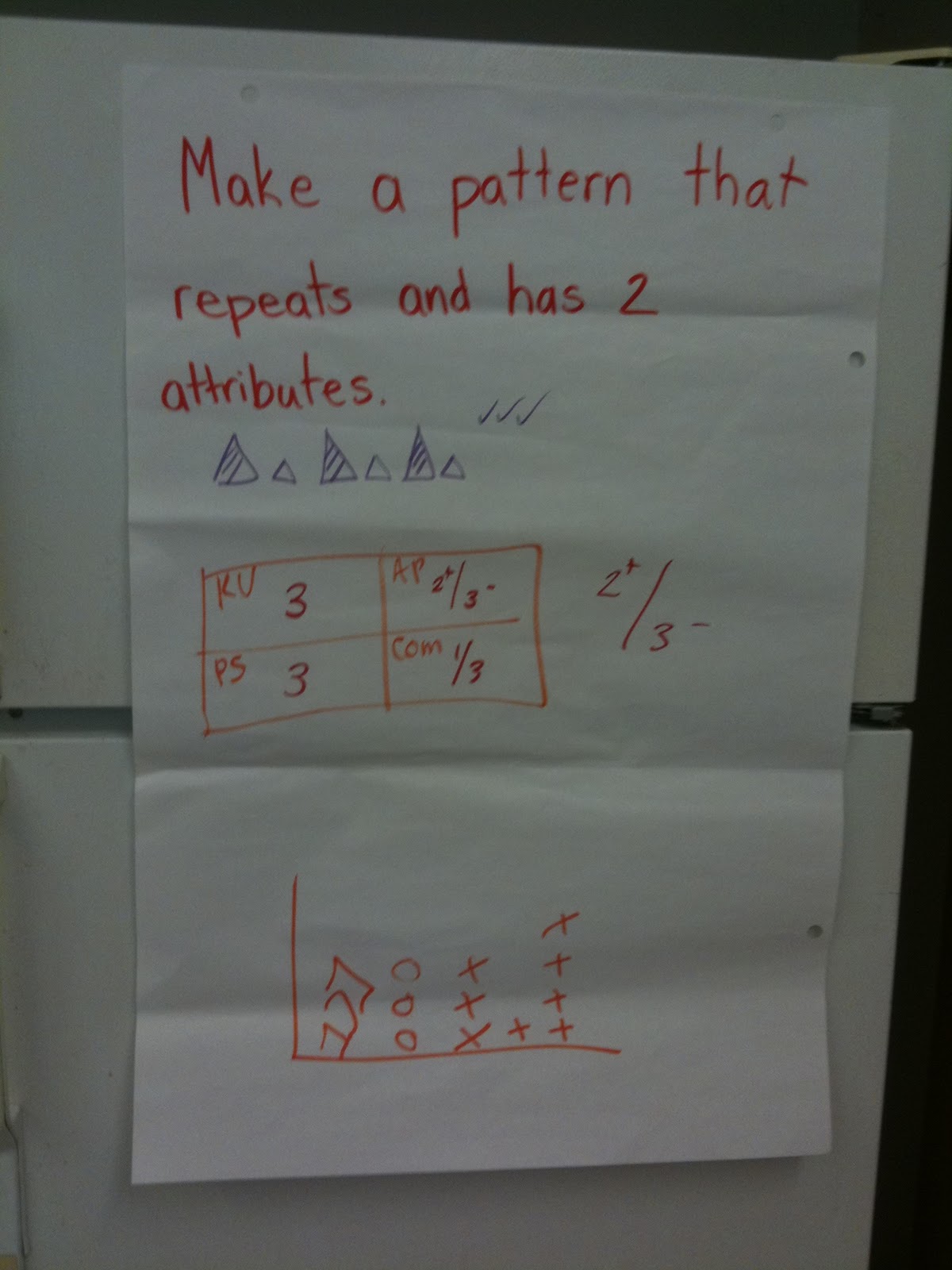
The primary division at Wexford asked just that question at the start of our pathway. In order to set up our pre-assessment task we needed to create a question. Not just any question, but a question that allowed us to not only meet all four levels of the achievement chart, but one that allowed our students to achieve at one of the four levels.
We looked at the above question (please ignore the writing below the purple pattern - it was our scratch pad for our thinking on another task). We asked ourselves if it was a "good question." Looking at the achievement chart, we noticed that it did cover knowledge and understanding - It shows us if the student can make a pattern and knows what attributes are. Our next question became "Can a student achieve a Level 4 on this question?" After some debate and discussion we concluded that no, they couldn't. Quite simply because we didn't give them the chance to demonstrate they had thorough knowledge of patterns.
The second problem we looked at was very different. As we went through the achievement chart, we were able to identify how the solution would allow the students to demonstrate their knowledge in each area, and at different levels. It also allowed us to anticipate student solutions, and discuss ways that the student could improve in their answer.
For the pre-assessment, the teachers came up with a very open, very appealing question for the students. It also was able to be used from Grade One to Grade Three. It was along the lines of:
Our school council wants to design a new school t-shirt. They want it to have a pattern that has different attributes on it. What could the shirt look like? Explain the pattern.
The primary division at Wexford asked just that question at the start of our pathway. In order to set up our pre-assessment task we needed to create a question. Not just any question, but a question that allowed us to not only meet all four levels of the achievement chart, but one that allowed our students to achieve at one of the four levels.
We looked at the above question (please ignore the writing below the purple pattern - it was our scratch pad for our thinking on another task). We asked ourselves if it was a "good question." Looking at the achievement chart, we noticed that it did cover knowledge and understanding - It shows us if the student can make a pattern and knows what attributes are. Our next question became "Can a student achieve a Level 4 on this question?" After some debate and discussion we concluded that no, they couldn't. Quite simply because we didn't give them the chance to demonstrate they had thorough knowledge of patterns.
The second problem we looked at was very different. As we went through the achievement chart, we were able to identify how the solution would allow the students to demonstrate their knowledge in each area, and at different levels. It also allowed us to anticipate student solutions, and discuss ways that the student could improve in their answer.
For the pre-assessment, the teachers came up with a very open, very appealing question for the students. It also was able to be used from Grade One to Grade Three. It was along the lines of:
Our school council wants to design a new school t-shirt. They want it to have a pattern that has different attributes on it. What could the shirt look like? Explain the pattern.
Subscribe to:
Posts (Atom)